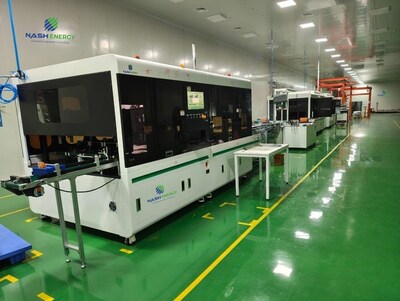

Nash Energy has begun operation of a 2 GWh fully automated prismatic battery pack production line at its Dobbaspet facility in Bengaluru. This first-phase installation forms part of a long-term plan to build up to 10 GWh of annual battery pack manufacturing capacity over the next five years. The adaptable line can assemble packs in multiple form factors, covering capacities from 100 Ah to 314 Ah, and will serve applications that include battery energy storage systems (BESS), electric vehicles, material handling equipment, and electric buses and trucks.
Equipped with advanced automation tools and rigorous quality-control systems, the new line is designed to deliver “Made in India” products that meet international performance and safety standards. Nash Energy says this expansion underscores its commitment to developing domestic capabilities in energy storage technologies.
India has set a target of reaching 500 GW of non-fossil fuel capacity by 2030, and industry experts view energy storage as a critical component of the country’s renewable energy transition. Data from NITI Aayog show that as of November 2025, coal still accounted for 67.77 percent of India’s power mix, while solar and wind combined contributed about 15 percent. As the share of renewables grows, demand for reliable grid-scale and transport-focused storage solutions is expected to rise sharply.
Nash Energy was the first company to mass-manufacture lithium-iron-phosphate cells in India and currently operates an R&D centre in Japan. The company is also establishing an India Engineering Centre to support further innovation in the nation’s energy storage ecosystem.
“We are making long-term investments to build indigenous capabilities and make India self-sufficient in energy storage technologies,” said Sanjay Wadhwa, Chairman of Nash Energy. “The country currently lacks adequate R&D depth in this domain, and our focus is on building a strong foundation that can support India’s clean energy ambitions. As renewable energy becomes a larger part of the national grid, a robust energy storage ecosystem is not optional—it is essential.”
Industry forecasts back this outlook. The India Energy Storage Alliance projects BESS capacity additions in India to grow from 507 MWh today to roughly 5 GWh in the coming years. MarkNtel Advisors estimates the Indian BESS market will reach USD 1.2 billion by 2030, at a compound annual growth rate of 27 percent.
Source: PR Newswire