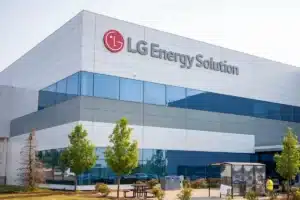


NextStar Energy Ltd. plans to begin commercial production at its $5 billion lithium-ion facility in Windsor, Ontario, next month, focusing initially on energy storage systems (ESS) rather than electric vehicle (EV) batteries. The shift follows a slowdown in EV sales, which accounted for 9.2 percent of new vehicle registrations in the second quarter of 2025, down from 18.9 percent in the previous quarter, according to industry data.
Developed as Canada’s first large-scale battery manufacturing plant, the 4.23 million-square-foot complex was completed last month after three years of construction. It is operated by NextStar, a joint venture between Stellantis and LG Energy Solution, and has received about $1 billion in support from federal and provincial governments. The plant employs more than 1,000 people and is expected to hire an additional 1,500 workers as production ramps up.
Danies Lee, NextStar’s chief executive, said that the ESS market provides an “opportunity” to utilize the factory’s capacity while EV demand recovers. ESS batteries store electricity during off-peak periods for use during peak times, enhance grid reliability during outages and support renewable integration. Increased global demand for electricity, driven in part by artificial intelligence adoption, is creating strong growth prospects in this segment.
To serve the ESS market, NextStar will adapt its equipment to produce lithium iron phosphate (LFP) batteries, which use iron phosphate cathodes and are well suited for stationary applications. These batteries are heavier and less energy dense than the nickel-manganese-cobalt (NMC) chemistries common in EVs, but they offer cost advantages, durability and longer lifespans for grid-scale projects.
While the first production line is set to roll out LFP cells in mid-November, NextStar also plans future lines for NMC batteries as the EV market recovers. The company’s agreement with government partners remains intact as long as hiring and operations targets are met.
Ontario has already signaled strong ESS demand, awarding 1,784 megawatts of battery capacity in 2024—enough to power 1.7 million homes—at prices 24 percent lower than a similar procurement the previous year. NextStar’s entry into this market positions Canada’s first gigafactory to support both grid stability and the nation’s broader energy transition.
Source: Yahoo Finance