
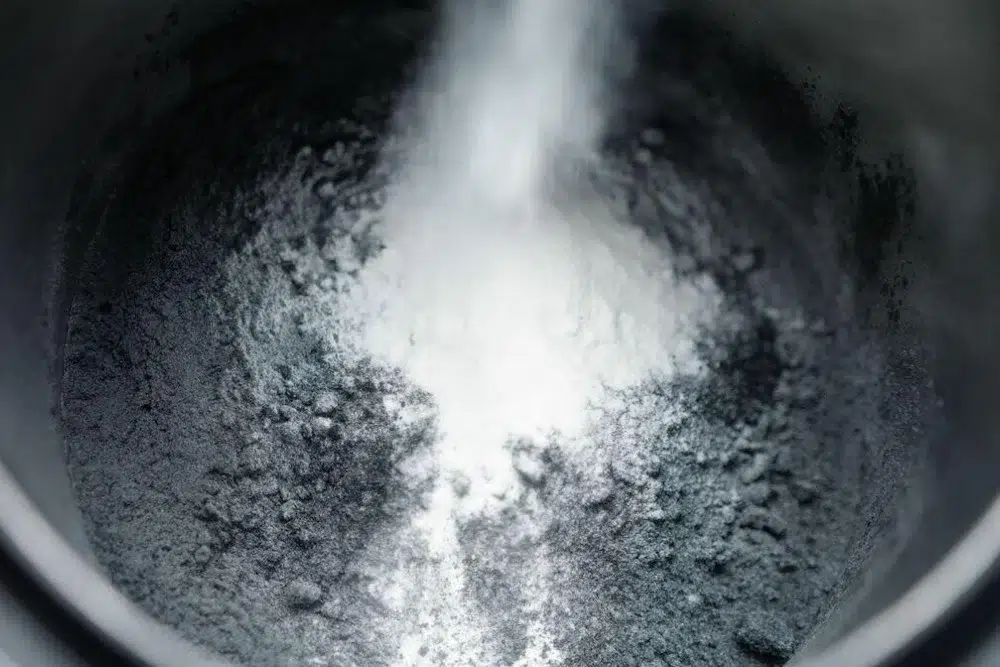

Researchers at RWTH Aachen University’s Chair of Production Engineering of E-Mobility Components (PEM) and industry partner SURAGUS have launched “MixItUp,” a collaborative project to develop an inline, real-time measurement system for functional pastes and slurries used in battery production. Traditional electrical characterization methods for these materials rely on time-consuming laboratory analyses and do not support immediate process adjustments. The MixItUp team aims to address this limitation by integrating an eddy current sensor with FPGA-based real-time signal processing directly into the slurry mixing process.
The integrated sensor is designed to measure key electrical properties—such as conductivity, homogeneity, and particle distribution—without interrupting production. Data from the sensor will be logged alongside standard process parameters in a database, enabling continuous monitoring, early fault detection, and more precise process control. After initial validation in a test rig, the method will be transferred to a pilot production line to demonstrate its robustness under industrial conditions.
The inductive sensor system consists of a measuring probe or an externally mounted unit, evaluation electronics, and software algorithms capable of interpreting high-frequency eddy current signals. By drawing on SURAGUS’s expertise in non-destructive eddy current testing of thin conductive layers, the project will adapt this technology for the first time to liquid multiphase suspensions.
While SURAGUS focuses on designing and prototyping the sensor hardware, PEM researchers are defining relevant measurement variables, conducting experimental calibration using different paste formulations, and developing a control strategy that integrates real-time measurements into existing mixing processes.
Upon completion, MixItUp aims to deliver a fully functional demonstrator system for at least two applications: electrode paste mixing in battery cell manufacturing and a second case involving another functional paste—such as fuel cell inks or printed electronics. The project is expected to reduce material waste, lower production costs, and pave the way for more adaptive and efficient battery slurry manufacturing.
Source: PEM RWTH Aachen University