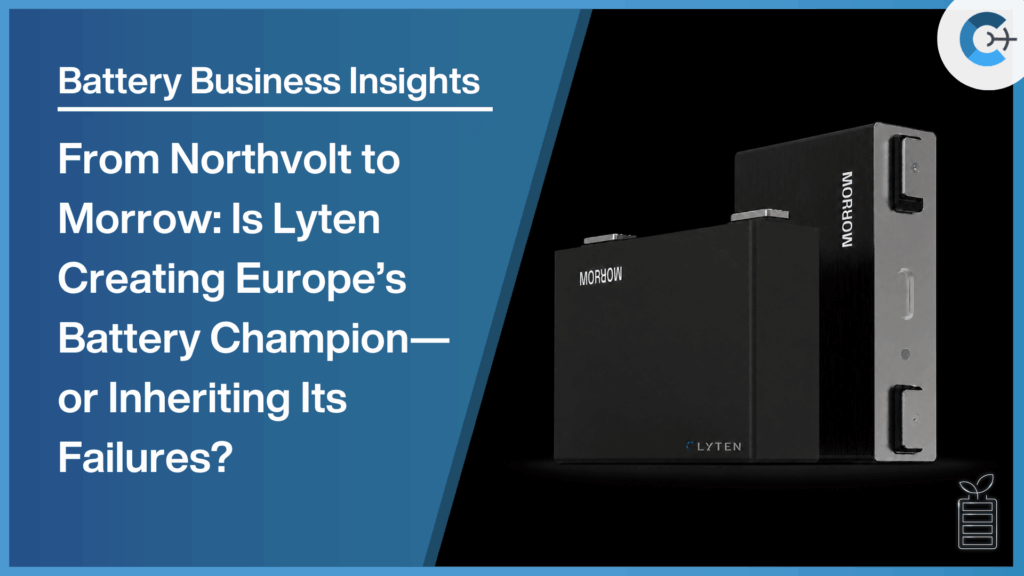

Welcome back to this week’s Battery Business Insights article on Lyten’s European expansion. On 21 August 2026, the bankruptcy estates behind Morrow Batteries signed a memorandum of understanding with Lyten and Innovation Norway for a proposed going-concern sale. That news extended a deal sequence that already includes completed acquisitions in Poland and Sweden, but it did not give Lyten control of Morrow.
The distinction matters for two reasons. First, Lyten’s completed platform is smaller than its announced four-country footprint. Second, buying distressed equipment below replacement cost does not remove the problems that broke Northvolt and Morrow: yield, customer qualification, working capital and the cost of operating factories before they reach stable volume.
This is therefore not yet a story about a European battery champion. It is a test of whether a private US company can turn separately distressed assets into a sequenced industrial system—and whether lithium-sulfur can become more than strategic option value while the acquired plants first make conventional products.
By the Numbers: Ownership, Capacity and Capital
- 2 completed European site acquisitions: Northvolt Dwa in Poland, plus Northvolt Ett, Ett Expansion and Northvolt Labs in Sweden.
- 3 unfinished processes: Revolt under a binding agreement, Northvolt Drei under an exclusive MOU, and Morrow under a preferred-bidder MOU.
- 16 GWh: manufacturing capacity included in the Swedish acquisition, according to Lyten—not demonstrated annual output.
- 6 GWh: equipment capacity at Dwa, with a company-stated expansion path to 12 GWh.
- Approximately $5 billion: Lyten’s stated book value for the Northvolt manufacturing assets, not the disclosed purchase price.
- More than $625 million: cumulative equity investment reported by Lyten after a July 2025 raise of more than $200 million.
- Up to $650 million: US Export-Import Bank letters of interest—potential financing, not cash already available.
- 8,500 tonnes per year: installed recycling capacity reported for Revolt, whose closing was still not publicly confirmed by 29 August.
- 1 GWh: Morrow’s Arendal nameplate capacity; the company began deliveries before bankruptcy but had not completed a stable ramp.
- Around 70 jobs: the Morrow sale process was expected to preserve through autumn in the short term.
- More than 600 hires: Lyten’s 12-month target for Skellefteå and Västerås, contingent on expected customer demand.
Lyten’s European footprint — what is owned and what is still in process
Acquisition completed Oct 2025. 6 GWh equipment capacity, BESS manufacturing.
Acquisition completed Feb 2026. 16 GWh reported capacity, R&D centre.
Binding agreement Mar 2026. Closing not verified by Aug 2026. Recycling.
Exclusive MOU Jul 2026. Definitive sale targeted Q3 2026. Prepared land.
Preferred-bidder MOU Aug 2026. Proposed going-concern sale, subject to conditions.
The Portfolio Is Real—but the Footprint Is Smaller Than the Announcements
Lyten completed the acquisition of Northvolt Dwa in Gdańsk on 16 October 2025. The 25,000-square-metre BESS manufacturing and R&D facility contains equipment that Lyten says can support 6 GWh of annual manufacturing capacity and later expand to 12 GWh. The company called Dwa Europe’s largest BESS manufacturing facility; that ranking is, however, a Lyten statement rather than an independently established market position.
On 27 February 2026, Lyten completed the Swedish acquisition covering Northvolt Ett, Ett Expansion and Northvolt Labs. Legal title to those assets transferred. Lyten reported 16 GWh of installed manufacturing capacity and described Labs as Europe’s largest and most advanced battery R&D centre. Neither capacity nor ranking proves current utilisation, yield or sales.
Lyten entered a binding agreement to acquire Revolt on 13 March, with closing expected in the second quarter. An August report said the bankruptcy estate was still clearing materials and reducing the remaining workforce, so no completed Revolt transfer could be verified yet. The German process is earlier: Lyten signed an exclusive MOU on 1 July for the 110-hectare Northvolt Drei site, with a definitive agreement targeted for the third quarter. The reported €60 million price was not disclosed in the MOU.
Morrow is earlier still. Its bankruptcy estates and Innovation Norway selected Lyten as preferred bidder under an MOU, subject to final documents and conditions outside the estates’ control. The official announcement withheld the terms. That means the reported NOK 8 million exclusivity payment should not anchor the analysis without the underlying transaction document.
Failed Assets Can Be Cheap Without Being Easy
The acquisition thesis is built on the foundation of capital efficiency. Lyten is not reproducing Northvolt’s entire greenfield programme. It is taking over land, utilities, buildings, equipment, intellectual property and teams after prior owners absorbed much of the initial cost. That reduces the entry price; it does not reset the operating physics.
Northvolt entered US Chapter 11 in November 2024 with approximately $5.8 billion in debt and about $30 million in cash. It had once reported an order book above $50 billion, including automakers such as BMW, Volkswagen, Volvo Cars and Audi. Yet BMW cancelled a €2 billion contract after delays, and Northvolt struggled to scale qualified output. Demand on paper did not compensate for weak execution at the factory.
Morrow failed later in the curve but not before production. The Arendal company declared a commercial start of production in January 2026 and began delivering LFP cells to Proventia in April under an agreement running to 2031. Bankruptcy followed on 6 May after liquidity ran out. Morrow itself cited capital-intensive industrialisation, oversupply, price pressure, higher capital costs and delays. The accurate conclusion is not that Morrow never produced cells; it is that initial production and deliveries did not become a financially durable ramp.
That historical context alters the burden of proof. Book value is not purchase consideration. Nameplate capacity does not equal qualified capacity. A line that can make cells is not necessarily a line that can make them repeatedly, at target yield, with warranties and positive contribution margin.
The Industrial-Hub Logic Is Coherent
The strongest version of Lyten’s case is a connected system rather than a collection of factories. Ett can restart with NMC cell production; Dwa can assemble BESS products; Labs can support NMC development and lithium-sulfur industrialisation; Revolt could add recycling if its acquisition closes. The pieces have a plausible technical relationship.
Lyten also linked the Skellefteå site to EdgeConneX. The data-centre developer plans to acquire land with potential for a campus of up to 1 GW, and Lyten said capital from that investment helps fund its Northvolt acquisitions. This is a financing and land-use strategy, not proof of battery demand. A potential one-gigawatt data-centre site is neither commissioned load nor battery revenue.
Germany and Norway could extend the model, but they also multiply interfaces: four legal systems, legacy workforces, public lenders, local permits, suppliers and different stages of industrial readiness. Drei is prepared land with utilities, not an operating gigafactory. Morrow adds a factory and technical team, but also a bankruptcy process and another ramp requiring cash. Integration benefits arrive only after transaction and restart risk.
Why cheap assets are not the same as easy turnarounds
Lyten-reported book value of Northvolt manufacturing assets. Not the purchase price.
Cumulative equity raised by Lyten. Covers the whole company, not only European operations.
Lyten’s stated restart target for NMC cells at Ett. Plan, not outcome.
Lithium-Sulfur Is Strategic Option Value, Not Current Scale
Lyten’s differentiator is LytCell lithium-sulfur. The company claims up to 50% lower weight than NMC and up to 75% lower weight than LFP on an equivalent-energy basis. It also says a San Jose pilot line converted from lithium-ion equipment for less than 3% of original capital and reached yields above 90% for pouch and cylindrical cells. These are company-reported pilot-line results, not independent gigafactory evidence.
There is commercial signal at small scale. Lyten markets lithium-sulfur cells for UAVs and says multi-year qualification is under way for vehicles, trucks, delivery vehicles and aviation. Those statements support a real development programme. They do not establish repeat high-volume revenue, automotive nomination or multi-GWh production.
The near-term European plan remains conventional. Ett is intended to restart NMC production and supply cells to Dwa in the second half of 2026. Labs is meant to help industrialise lithium-sulfur later. Lyten must first operate the inherited lithium-ion system while funding a chemistry transition whose scale-up economics remain unproven.
The Nevada timetable sharpens that point. In 2024, Lyten announced a more-than-$1-billion lithium-sulfur factory near Reno, with a first phase targeted for 2027. In January 2026, the Reno–Tahoe Airport Authority said lease talks for that site had ended. Lyten disputed that the Nevada commitment was cancelled, but acknowledged that acquisitions had shifted the schedule and said it remained interested in another Nevada path. The original site and 2027 milestone are no longer reliable evidence of an imminent gigafactory.
Customer Evidence Matters More Than Addressable Markets
Lyten’s target markets include data centers, defense, drones, autonomous systems, and mobility. The logic is credible: some customers may pay for low weight, local supply or energy resilience rather than the lowest commodity-cell price. Automotive qualification will take longer, and Lyten has said as much.
Still, an addressable market is not an order book. Acquired IP and product portfolios do not automatically transfer customer contracts. Conversely, the draft’s implication that the assets came with no customer evidence went too far: Morrow had a long-term Proventia agreement and made initial deliveries, while Lyten said Dwa was restarting to fulfil orders. The unresolved question is continuity—what contracts transferred, at what volume and margin.
For investors and industrial partners, the useful disclosure is therefore not a list of sectors. It is qualified capacity, contracted volume, repeat shipments, warranty performance and contribution margin by site.
Five tests that would prove the turnaround is working
Close the status gap. Move Revolt, Drei and Morrow to verified transfers — or remove them from the footprint.
Report operating evidence. Repeat BESS deliveries from Dwa; commercial cells from Ett with yield data.
Disclose financing. Site-level restart budgets, committed capital and working-capital needs.
Separate chemistry. Independent Li-S cell data, third-party qualification and a funded US scale-up path.
Show sequencing. A smaller number of factories at stable output beats a larger map of conditional assets.
Sequencing Is the Strategy
The positive case deserves to be stated plainly. Lyten acquired European infrastructure after much of the greenfield cost had already been spent. It may have retained experienced leaders, gained BESS products and R&D capability, and found a way to monetise part of the Skellefteå site. Brownfield reuse can be more rational than another subsidised factory built from zero.
The counter-case is that Lyten is moving faster in transactions than in disclosed operating proof. More than $625 million of cumulative equity is meaningful, but it covers a broader company and does not reveal unrestricted cash, site-level burn or restart budgets. Export-credit letters of interest are not committed operating liquidity. Terms for the Swedish purchase, Revolt, Drei and Morrow remain partly or wholly undisclosed.
Management attention is another scarce resource. Dwa needs commercial output; Ett needs a controlled restart; Labs needs an R&D agenda; Revolt still needs closing and partners; Morrow needs a final transaction and operating plan. Starting everything at once would recreate the scale-before-stability error that weakened Northvolt.
The strategy is strongest if each asset earns the right to unlock the next one. That means legal closing before integration claims, stable output before expansion, qualified revenue before capacity additions, and a funded lithium-sulfur route before conversion promises.
What Would Prove the Turnaround Is Working
First, close the status gap. Revolt, Drei and Morrow should move from announced processes to verified transfers—or be removed from descriptions of the controlled footprint.
Second, report operating evidence. Dwa requires consistent BESS deliveries. Ett needs commercial cells in the second half of 2026, followed by yield, utilisation and customer-qualification data.
Third, disclose financing durability. Site-level restart budgets, committed capital, working-capital needs and the treatment of public support would show whether the platform can survive slower ramps.
Finally, show sequencing. A smaller number of factories reaching stable output would be stronger evidence than a larger map of conditional assets.
Lyten owns a meaningful battery platform in Poland and Sweden. It does not yet control the full Sweden–Poland–Germany–Norway system implied by its announcement sequence. Revolt lacks a verified closing, Drei remains under an exclusive MOU, and Morrow remains a preferred-bidder process.
The investment thesis is credible but not yet proven. Distressed assets can lower replacement costs, but they cannot substitute for yield, customers, cash discipline, or management focus. Lithium-sulfur may eventually differentiate the platform, but the immediate test is simpler: restart conventional production, ship qualified products, and finance each step without repeating the scale-before-stability pattern that failed the assets’ previous owners.
Battery Business Insights is an independent industry publication. Company specifications and forward-looking targets are identified as company-reported. Independent third-party verification of Lyten’s cell-level performance and gigawatt-scale lithium-sulfur manufacturing claims was not confirmed at the time of writing.
References: Lyten: Northvolt Dwa completion; Lyten: Swedish acquisition completion; Lyten: Revolt binding agreement; Lyten: Northvolt Drei MOU; Morrow bankruptcy administrator: preferred-bidder MOU; Morrow: Proventia deliveries; Reuters: Northvolt and Lyten background; Lyten: lithium-sulfur claims; News 4: Reno–Stead lease outcome; 2 News Nevada: Lyten’s revised Nevada position.