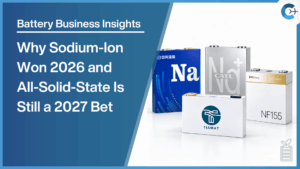
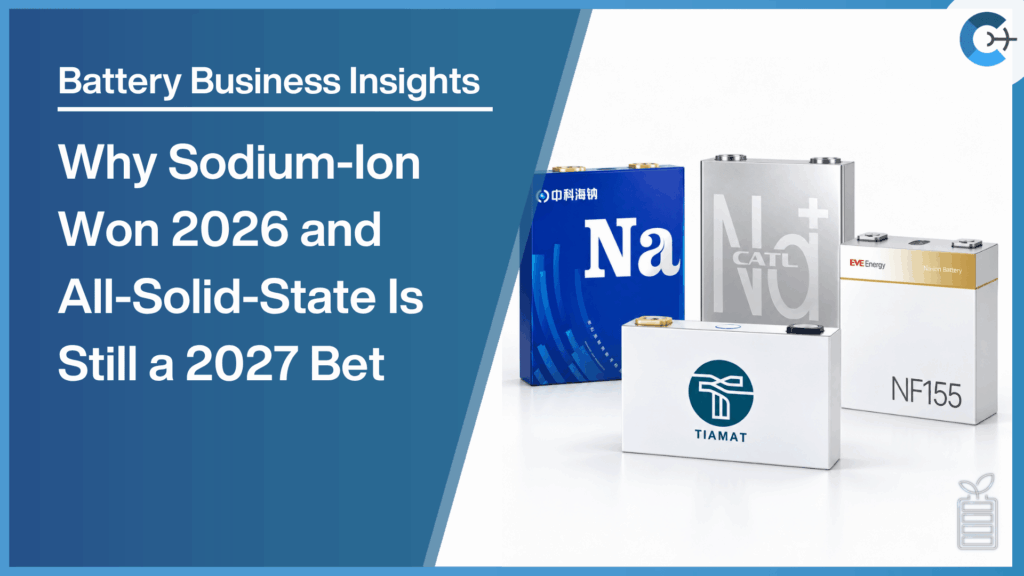

Welcome back to this week’s Battery Business Insights article on sodium-ion and solid-state batteries and what is actually in production in 2026. Both chemistries are arriving, but neither in the shape the headlines promised. Sodium-ion reached commercial scale this year, late and at a price premium. Solid-state did not cool off; it grew, but only in a semi-solid form.
Semi-solid cells, which keep some liquid electrolyte beside a mostly solid one, made up every solid-state battery shipped at commercial scale in 2025. EVTank’s white paper of 31 July 2026 puts global solid-state shipments at 8.0 GWh, up 51.9% on the year before. In September, a storage tender in Renqiu, Hebei, put a price on the other newcomer. Sodium-ion systems were bid at an average of about $153 per kWh (1.0322 yuan/Wh), against $79 per kWh (0.5318 yuan/Wh) for lithium iron phosphate (LFP) in the same project. For a buyer, the question is no longer whether these batteries exist, but what they cost and in which form.
By the Numbers: Semi-Solid Ships, Sodium Scales, All-Solid Waits
- 8.0 GWh — Global solid-state battery shipments in 2025, up 51.9%; all commercial volume was semi-solid. (EVTank via ChinaEVHome, July 2026)
- 607.2 GWh — EVTank’s forecast for solid-state shipments in 2030, with all-solid-state cells at nearly 20% of that. (EVTank, July 2026)
- 1 GWh — CATL’s target for cumulative sodium-ion storage shipments by the end of 2026. (CATL, June 2026)
- 60 GWh — Three-year sodium-ion supply agreement between CATL and HyperStrong, signed on 27 April 2026. (CATL, May 2026)
- $153 against $79 per kWh — Average sodium-ion and LFP system bids in one 100 MW/400 MWh tender in Renqiu (1.0322 against 0.5318 yuan/Wh). (CNESA, September 2026)
- H2 2027 — Samsung SDI’s planned start of all-solid-state mass production in Ulsan. (Gasgoo, July 2026)
Sodium-Ion and Solid-State Dates Have Slipped Before
When CATL launched its first-generation sodium-ion cell in July 2021, at up to 160 Wh/kg, it planned to form a basic industrial chain by 2023. BYD began building a 30 GWh sodium-ion plant in Xuzhou in January 2024. In 2026, CATL is shipping, while BYD still ties its mass-production date to demand.
Solid-state has the longer record of moved dates. Toyota first planned solid-state batteries for 2020, moved them to 2023 and then 2026, and now targets 2027–2028 (Electrek). QuantumScape said in 2020, when it went public, that it was aiming for commercial production in 2024. In this field, a 2027 date is a target, not a schedule.
Sodium-ion has its own failure on record. US maker Natron Energy ceased operations on 3 September 2025 after failing to raise funding, abandoning a planned $1.4 billion factory in North Carolina. A funding gap ended that gigafactory before it was built.
Sodium-Ion Ships From China; Solid-State Ships as Semi-Solid
Sodium-ion’s commercial step in 2026 rests mostly on CATL. CATL and Changan unveiled what they call the first mass-production passenger car with sodium-ion batteries on 5 February, due on the market by mid-2026. Its Naxtra cells reach up to 175 Wh/kg, by CATL’s figure. In storage, CATL plans first deliveries in China in September and 1 GWh of cumulative shipments by the end of 2026. It has added 40 GWh a year of capacity at Fuding and holds the 60 GWh HyperStrong order. These are targets and orders; no completed delivery had been independently reported by early October.
Elsewhere, sodium-ion is entering heavy vehicles one unit at a time. HiNa Battery and Tonly delivered a sodium-ion mining truck with a 676 kWh battery to Sanyou Mining in July. FAW Jiefang’s sodium-ion heavy truck, built with HiNa, covered more than 15,000 km in road tests and kept more than 90% of its usable capacity at −40 °C. BYD says it has sodium-ion cells rated for up to 10,000 cycles, with mass production timed to demand. Cold weather and heavy-duty work are where sodium is being tested first.
Solid-state, meanwhile, is shipping as a hybrid. WeLion and Qingtao led 2025 shipments with nearly half the market between them, according to EVTank. WeLion’s 150 kWh semi-solid pack is in NIO cars, and Qingtao’s cells are in the SAIC MG4. China’s regulators prepared to rename these cells “solid-liquid batteries” so they are not confused with the fully solid kind. A buyer of solid-state today is buying a hybrid.
All-solid-state cells remain at the pilot and test stage. At the end of August 2025, a lightly modified Mercedes EQS with lithium-metal cells from Factorial drove 1,205 km from Stuttgart to Malmö without recharging, arriving with 137 km of range left, according to Mercedes-Benz. QuantumScape opened its Eagle pilot line in San Jose in February 2026 to build cells for customer samples. Samsung SDI plans mass production in Ulsan from the second half of 2027, and BYD plans small-batch trials of roughly 1,000 vehicles around 2027. The step from test fleet to production line is still ahead.
Cost Sets Sodium’s Pace, Manufacturing Sets Solid-State’s
Sodium-ion’s remaining gap is mostly a price gap. In the Renqiu tender, the 40 MWh sodium lot drew an average bid of $153 per kWh (1.0322 yuan/Wh), while the 360 MWh LFP lot averaged $79 per kWh (0.5318 yuan/Wh) (CNESA). The lots differed in size, so the gap is a market signal rather than a pure chemistry difference. On his own cost basis, HiNa’s general manager puts sodium-ion at $74–104 per kWh (0.5–0.7 yuan/Wh) against $45–74 (0.3–0.5 yuan/Wh) for lithium batteries, and expects the two to converge in 2027 or 2028. For now, a sodium-ion buyer pays extra for supply diversity.
The pressure that could close that gap comes from lithium. Lithium carbonate rose above $25,000 per tonne (170,000 yuan) in early 2026. Industry estimates put hard-carbon anode costs at $5,200–5,900 per tonne (35,000–40,000 yuan) in 2026, down from $8,900–10,400 (60,000–70,000 yuan) in 2024. China also exempts sodium-ion and solid-state batteries from a new battery consumption tax until the end of 2028, while lithium-ion pays 2% from September 2026. Raw materials and policy both push in sodium’s direction.
All-solid-state’s gap sits in the factory. Specialised sulfide precursors still cost dozens of times as much as conventional liquid-electrolyte materials, according to CarNewsChina’s reporting on BYD’s programme. Both newcomers also start from a small base: global lithium-ion shipments reached 2,280.5 GWh in 2025, by EVTank’s count. Neither chemistry yet moves the market leader.
Forecasts Still Run Ahead of the Factories
The sceptical reading still has evidence. EVTank’s 607.2 GWh for 2030 is a forecast, and it expects all-solid-state cells to be only nearly 20% of that. BYD’s chief scientist, Lian Yubo, has said liquid lithium-ion and all-solid-state batteries could coexist for 15 to 20 years. Natron’s closure shows that a sodium-ion business can fail on funding before its factory exists. The arrival is real, but slower and narrower than the announcements.
Bottom Line
Both chemistries are real products in 2026, and both arrived later and narrower than announced. For a storage buyer, sodium-ion is an option from late 2026, mainly from one supplier at scale and, in the one public tender, at about twice the price of LFP. For a vehicle buyer or investor, semi-solid is what ships; all-solid-state is a bet on 2027 to 2030 in a field with a history of slipped dates. In Renqiu, sodium took a tenth of the project, and that share is the honest measure of where it stands.
Battery Business Insights is an independent industry publication. Figures reflect the most recent data available at the publication date. Company targets, forecasts and tender bids are stated as such and are not confirmed outcomes. Dollar values are converted at 6.733 yuan per dollar, the PBOC central parity of 9 October 2026.
References: CATL (1, 2, 3, 4); CarNewsChina (1, 2, 3, 4); QuantumScape (1, 2); Electrek; Mercedes-Benz; ChinaEVHome (1, 2); Gasgoo; Manufacturing Dive; CNESA; Reuters; CnEVPost (1, 2); Energy-Storage.News.