
PowerCo SE, Volkswagen Group’s battery company, is executing a scale plan centered on a unified prismatic cell, a replicated “standard factory” blueprint, and three gigafactories in Salzgitter (Germany), Valencia/Sagunto (Spain), and St. Thomas (Canada). The aim: up to 200 GWh/year of localized battery cell capacity to serve Volkswagen brands first and, over time, selected external needs in stationary storage and advanced chemistries. With Salzgitter commissioned in December 2025, materials secured via IONWAY (the Umicore JV) and a solid‑state licensing path with QuantumScape, PowerCo’s model explains how it plans to deliver scale, cost discipline, and supply assurance across Europe and North America.
PowerCo’s Three-Hub Capacity Plan
Volkswagen’s battery subsidiary is building up to 200 GWh/year of cell capacity across three gigafactories in Germany, Spain, and Canada.
Key Facts & Figures
- Founded: 2022
- Headquarters: Salzgitter, Germany
- Employees: 2,000+
- Ownership: Volkswagen Group subsidiary
- Planned capacity: Up to 200 GWh/year across three sites
- Sites: Salzgitter (up to 40 GWh), Valencia/Sagunto (40→60 GWh), St. Thomas (up to 90 GWh)
- Production milestones: Salzgitter commissioned Dec 17, 2025; Valencia production 2026–2027; St. Thomas start targeted 2027
- Technologies: Unified Cell (prismatic), LFP/NMC chemistries, solid‑state license; dry coating; standard factory design
- Partnerships: IONWAY (Umicore JV for CAM/pCAM), QuantumScape (solid‑state), Elli (energy), VW brands
- Revenue/market share: Not publicly disclosed
Company Background & Market Position
Founded in 2022 to concentrate Volkswagen’s battery activities, PowerCo SE manages cell technology, industrialization, and part of the value chain from its Salzgitter base. Frank Blome serves as CEO, with Sebastian Wolf as COO. The company operates in Europe and North America, with a mandate to supply Volkswagen, Audi, Škoda, and SEAT/CUPRA. PowerCo’s near‑term market position is anchored by internal demand from the Volkswagen Group, with energy storage solutions also in scope.
PowerCo’s central proposition is standardization: a unified prismatic cell and a replicable factory template to lower complexity and cost. In a market where Asian incumbents dominate on scale and cost, PowerCo’s differentiation is regional localization, secure materials via IONWAY, and VW’s vehicle demand base. While the company has not published revenue or market share figures, it is positioned as a strategic supplier to Volkswagen’s EV programs, with optionality to serve external opportunities where it adds value.
The PowerCo Model: Four Pillars of the Scale Strategy
PowerCo’s approach to competing at scale rests on standardizing the cell, replicating the factory, localizing materials, and opening a path to solid-state.
Interview with PowerCo CEO Frank Blome,
In a recent conversation hosted by our colleague Simon Voss with PowerCo CEO Frank Blome, the discussion centered on how the Volkswagen Group’s battery company is moving from pilot runs to production while reshaping how European cell manufacturing competes. Blome says the team is now preparing first production samples at the new site after making roughly 100,000 trial cells with suppliers—an inflection point as logistics, materials, and customer testing lock in ahead of mass production.
Blome frames the motivation plainly: for EVs, the battery is the new engine. Performance, range, charging speed, and cost all stem from cell design and manufacturing quality. “You have to make sure you have this technology under control if you want to stay in business,” he notes. With Asia’s decades of head start, the bar is high on both cost and technology—but he argues PowerCo is positioned to close the gap with targeted chemistry, process, and factory innovations.
Cost pressure and charging speed are the core challenges. Materials drive the bill for NMC cells—around 80% of total cost—so purchasing and R&D must work in lockstep, backed by relentless benchmarking and value engineering. Europe’s higher operating costs make automation and efficiency non‑negotiable, while policy complexity and slow permitting add friction. Still, Blome stresses that competitiveness is a system problem: “It’s not one thing — it’s everything together that matters.”
PowerCo’s answer is a “unified cell” manufacturing strategy that separates equipment from single-use geometries. Instead of rebuilding a plant for each model, the company designed a family of cell formats that can run on the same lines—supporting entry LFP cells and high‑performance variants alike. The approach is chemistry‑agnostic by design: sodium‑ion and all‑solid‑state are treated as drop‑ins, with Blome estimating that more than 70% of capital equipment can be reused for solid‑state. Process upgrades arrive in steps—state‑of‑the‑art for the first plant, additional innovations (fast stacking, aging optimization, dry coating) in Valencia, and a next‑generation setup planned for Canada—each validated at the pilot site before rollout.
Blome sees room for European equipment makers to win by introducing true process innovations rather than replicating Asian designs. He also calls for faster, more pragmatic execution with policymakers, and a clear value case for investors: disciplined cost control, strong order books, and technology customers want. The market is large—cars, trucks, and fast‑growing stationary storage—and the payoff includes lower total cost of ownership and measurable CO₂ reductions.
Manufacturing Capacity & Infrastructure
PowerCo’s capacity roadmap is structured around three hubs:
- Salzgitter, Germany (up to 40 GWh): Commissioned on December 17, 2025, Salzgitter is the lead plant and blueprint for subsequent sites. It produces unified prismatic cells (initially NMC) and runs on 100% renewable electricity, with Volkswagen stating annual CO₂ savings on the order of 115,000 tons versus conventional operations. Initial output ramps around 20 GWh/year, expandable to 40 GWh with additional lines.
- Valencia/Sagunto, Spain (40→60 GWh): Designed for 40 GWh initially with potential to 60 GWh, this site targets production from 2026, with multiple sources indicating series supply in 2027 as construction and supplier park build out. The plant is intended to support VW Group vehicle plants on the Iberian Peninsula and operate on green energy.
- St. Thomas, Ontario, Canada (up to 90 GWh): The largest site in PowerCo’s plan, St. Thomas is targeted to reach up to 90 GWh at full buildout, with start of production in 2027, about 3,000 direct jobs, and investment reported in the ~US$5 billion/CAD$7 billion range by 2030. The Ontario location is in the Great Lakes automotive corridor to serve the North American market.
The “standard factory” approach replicates equipment, digital systems, and manufacturing flow across sites, enabling faster ramp and consistent quality. PowerCo also highlights dry coating and other process innovations aimed at energy efficiency and lower emissions.
Technology & Product Portfolio
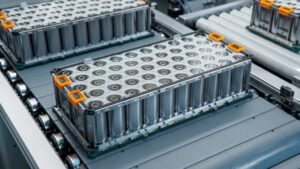
- Unified Cell (prismatic): A single cell format that can use LFP or NMC chemistries and is described as solid‑state‑ready. The unified format is planned to serve a broad range of vehicles—from cost‑optimized to high‑performance—and to underpin energy storage systems (ESS), where PowerCo offers cells, packs, and modular cubes.
- Chemistry flexibility: LFP supports cost and longevity targets, while NMC addresses higher energy‑density needs. This chemistry flexibility within one format reduces variant complexity across brands and platforms.
- Process and design: PowerCo points to dry coating and a cell‑to‑pack architecture in selected applications to improve manufacturing efficiency and system‑level performance.
- Materials integration via IONWAY: The IONWAY JV (with Umicore) will supply cathode active materials (CAM) and pCAM in Europe, beginning around 2025 and scaling toward 160 GWh of materials capacity by the end of the decade. The first CAM plant is located in Nysa, Poland, leveraging renewable energy and European refining.
- Solid‑state industrialization with QuantumScape: PowerCo has a non‑exclusive license to manufacture QuantumScape’s QSE‑5 solid‑state cells, currently providing rights to up to 45 GWh/year with a path to as much as 85 GWh/year if fully exercised. The collaboration includes deeper involvement in automation and pilot‑line output to speed tech transfer to PowerCo’s factories.
PowerCo Production Milestones: 2025–2027
Three gigafactories coming online in sequence across two continents.
Strategic Initiatives & Market Context
Public interest centers on three questions: what PowerCo does, where it builds, and how it will compete. The company is Volkswagen’s battery arm, focused on cell manufacturing rather than electricity retailing. Its factories in Germany, Spain, and Canada are designed to improve regional supply security and meet content rules and regulatory expectations in the EU and North America.
On competitiveness, PowerCo’s strategy is to standardize the cell and factory design, localize materials through IONWAY, and scale where VW’s vehicle demand is concentrated. The company states a commitment to responsible sourcing, closed‑loop materials, and carbon‑neutral production at its sites—key to EU Battery Regulation compliance. For customers asking whether PowerCo sells beyond Volkswagen, the primary focus remains VW Group programs; however, ESS offerings and the QuantumScape license (with some rights for non‑VW QSE‑5 output) show selective pathways to serve external demand.
Looking Ahead
PowerCo’s near‑term execution hinges on three steps: a steady ramp at Salzgitter through 2026, on‑time Valencia start with supplier park integration, and St. Thomas construction toward a 2027 start. Together with IONWAY’s CAM supply and a measured solid‑state path with QuantumScape, the company has assembled the ingredients to scale to 200 GWh while reducing logistics risk and emissions.
How is PowerCo building that capacity? By pairing a unified prismatic cell with a repeatable factory template, siting plants close to vehicle production, and locking in materials through European partnerships. If demand, policy, and industrial ramp milestones align, the three‑hub plan gives Volkswagen a credible internal source of EV cells and the flexibility to support storage markets—answering the strategic need for scale and supply assurance across its core regions.