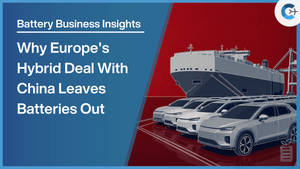
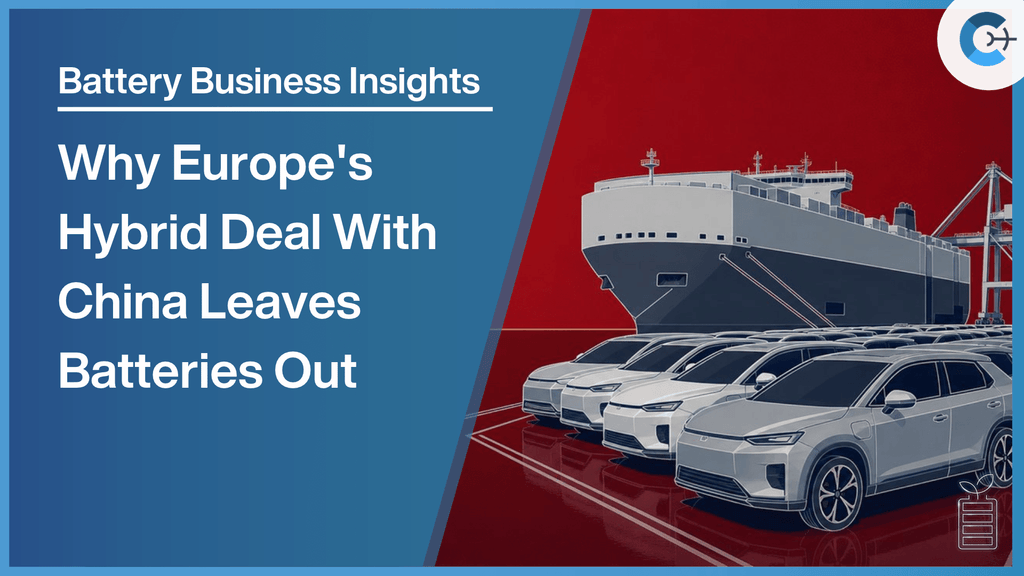

Europe now has a number for Chinese hybrids, and it says little about batteries. EU officials said on 12 October 2026 that imports will be capped at 350,000 cars in the first year, under a safeguard the Commission plans to launch on 1 December; none of it is law yet. Chinese carmakers are already in Beijing bargaining for their share of the quota, Cailian reported on 2 November. The battery lever that matters more, China’s export controls on cells, anode material and cell-making equipment, is not in the deal at all.
A hybrid (HEV) carries a small battery that the engine charges; a plug-in hybrid (PHEV) carries one large enough to charge from the grid. Both have been the open door around the EU’s 2024 duties on Chinese battery-electric cars. How far the cap closes that door, and what stays open for cell makers, decides whether this is a trade truce or a battery story.
By the Numbers: The EU’s Planned Hybrid Cap on China
- 350,000 — Chinese hybrids allowed in year one, rising 6% a year for four years, according to EU officials; not yet in a legal act.
- About 800,000 — Chinese hybrid imports the Commission expects in 2026, a projection cited by officials.
- 107,000 → 302,000 — EU hybrid imports from China, 2024 to 2025, Eurostat figures cited by China’s commerce ministry.
- 2% → 25% — Chinese brands’ share of Europe’s plug-in hybrid market, 2024 to the first half of 2026 (ACEA).
- 10% against up to 45.3% — The tariff a Chinese plug-in hybrid pays, against the total on a China-made battery-electric car from SAIC.
- Just over 20 kWh — The average plug-in hybrid battery in the EU in 2025 (IEA).
- 1 December 2026 — The planned launch of the safeguard, according to an EU official.
- 10 January 2027 — How long the US–China truce, under which China paused its battery export controls, now runs, according to China’s commerce ministry.
Timeline: From the EV Duties to the Hybrid Cap
- October 2024: countervailing duties on China-made battery-electric cars; hybrids keep the 10% tariff.
- June 2026: the EU asks for “concrete results” on its trade deficit with China by October.
- September 2026: the EU asks China to hold its hybrids to about 15% of the market, the Financial Times reports; on 18 September Beijing rejects “so-called voluntary export restraints”.
- 9 October: Šefčovič announces an understanding; the joint text carries no figure.
- 12 October: officials name the 350,000 cap and the safeguard route.
- 15–16 October: EU leaders call for “new instruments” without naming China.
- 2 November: carmakers in Beijing for talks on quota shares.
- 10 November: the legal end date of China’s battery export-control suspension; the US–China truce behind it runs to 10 January 2027.
- 1 December: the safeguard is due to be launched.
- January and March 2027: a ministerial video call, then the third round of EU–China consultations.
Hybrids Came In Through a Door the 2024 Battery Case Left Open
The 2024 anti-subsidy case was, in part, a battery case. Among the subsidies it examined was the government provision of batteries and lithium iron phosphate at less than adequate remuneration. Its duties, though, cover only new battery-electric cars, and they run until 30 October 2029. China-built battery-electric cars pay up to 35.3% on top of the standard 10% tariff; hybrids and plug-in hybrids pay the 10% alone.
That gap coincided with a surge. Monthly EU imports of Chinese hybrids rose from about 3,800 in October 2024 to about 50,000 in July 2026, according to the Financial Times, and Chinese brands’ share of Europe’s plug-in hybrid market went from 2% to 25%. BYD’s Dolphin G DM-i, its first plug-in hybrid developed for Europe, carries an 18.3 kWh Blade battery in its larger versions, according to the company. A battery the duty case looked at could still reach Europe inside a car it did not cover.
Brussels Calls It Halving, Beijing Calls It Growth, and Both Can Be Right
The only text both sides signed says they “reached an understanding on trade in hybrid vehicles in a WTO compliant manner”, with no volume, time frame or enforcement. Officials filled that in on 12 October: 350,000 cars in the first year, 6% more each year for four years, and customs stop clearing Chinese hybrids once the ceiling is reached. One official said that would cut current imports by more than half.
China’s commerce ministry tells it differently. The arrangement allows growth from the 302,000 hybrids the EU imported from China in 2025, it said on 12 October, and China’s quota will be no smaller than any other supplier’s. It named no figure. The two framings fit the same number: 350,000 is more than 2025’s imports and less than half of the about 800,000 the Commission expects for 2026. Which baseline the final measure uses is not public.
The instrument is a safeguard, which WTO rules require to cover imports from every origin. Japan, South Korea, Türkiye, the United Kingdom and the United States are expected to get their own quotas, Borderlex reported, and other exporters a shared one. Full, mild and plug-in hybrids are in scope; micro-hybrids, whose battery does not drive the car, are not. No notice of initiation had been published by 8 November. Meanwhile, carmakers are in Beijing bargaining for allocations; “the total quota is limited”, one person familiar with the talks told Cailian. Elsewhere in the package, price undertakings on battery-electric cars continue, and China will keep fast-tracking rare-earth and magnet licences. No source puts a value on that easing.
The Battery Question Is Settled in Talks Europe Is Not Part Of
For batteries, the cap matters in three places. The first is the packs. The average plug-in hybrid battery in the EU passed 20 kWh in 2025, so fewer imported plug-ins also means less China-made battery capacity arriving in cars, though no GWh figure can be put on it while the split between plug-ins and full hybrids under the cap is unknown.
The second is the plants. Cars Chinese brands build in the EU fall outside the cap, and officials told Borderlex that more Chinese car plants in Europe, plugged into European supply chains, would be a good outcome. BYD says mass production at its plant in Szeged, Hungary, starts in the fourth quarter. Whose cells go into those cars is the open question for European cell makers.
The third is the gap. In October 2025 China put export controls on lithium-ion cells, artificial graphite anode material and the equipment to make them, then suspended them on 7 November 2025 after talks with the United States. The legal text still gives 10 November 2026 as the end date. On 28 September, China’s commerce ministry said the US–China arrangement of October 2025 now runs to 10 January 2027, with talks on a further extension before year-end; its readout names no single measure, but the battery suspension came with that truce. The EU–China joint statement names rare earths and magnets and leaves batteries out. In this publication’s judgement, for cell plants running Chinese equipment and anode material, that truce matters more than 1 December.
Demand is the condition for any gain. Battery-electric cars took 21.7% of EU registrations from January to August 2026. A study ACEA commissioned from Mobility Global expects European cell output to reach 306 GWh by 2032, too late for the EU’s planned localisation timeline, and Bruegel estimates that EU-made cells could add €2,100 to the cost of a battery-electric car, as cited by ACEA. The Franco-German push on local battery content is covered in BTN’s analysis of that deal.
Chinese Plants Inside the EU Gain; Battery Supply Chains Stay Exposed
On the evidence so far, and partly by inference:
- Gains: European carmakers’ hybrid ranges, where Chinese brands took 14% of the full-hybrid market in the first half of 2026; Chinese makers with plants inside the EU, such as BYD.
- Pays: buyers of low-priced plug-in hybrids, if supply tightens; the other exporters, drawn into quotas of a safeguard set up for China; and battery supply chains, whose exposure is set in a truce between Washington and Beijing.
- Open: whether European cell and materials suppliers gain. No source shows it, and that depends on battery-electric demand and on whose cells new EU plants use.
Carmakers Call It Orderly; the Battery Industry Has Said Nothing
ACEA Director-General Sigrid de Vries said the announcement “can help facilitate the transition to a new era of Chinese presence in the European market in an orderly way”. ACEA called the deal “interim” and said buses and trucks will need to be addressed. VDA President Hildegard Müller called it “a first positive signal”, while Bernd Lange, who chairs the European Parliament’s trade committee, said “this was not yet a central breakthrough”. Lilin Liang of the China Chamber of Commerce to the EU said China kept the right to retaliate. In her view, Chinese companies would be “very hesitant to put billions and billions in Europe” unless energy, labour and compliance costs are addressed. No statement from a battery association or cell maker was found as of 8 November.
A Necessary Risk?
The legal case against the cap is strong. WTO rules ban voluntary export restraints, under which a country caps its own exports. Trade lawyer Victor Crochet and law professor Weihuan Zhou argue that a safeguard whose outcome was agreed with China in advance is hard to reconcile with the WTO Agreement on Safeguards. A quota based on 2025 imports also favours China over the three-year average the agreement takes as its base, and a quota tends to hold imports below its own level because ships take months to arrive. Beijing, meanwhile, keeps its right to retaliate.
The case for it is speed. Šefčovič said it was the first time Beijing had agreed to curb its exports without a prior EU trade investigation. A cap that arrives in weeks may be worth a legal risk that a full investigation would avoid.
Bottom Line
If it is enacted as described, the cap would settle the car question for four years. The battery question is settled elsewhere. What to watch: a notice of initiation and the quota table on 1 December, a Chinese notice moving the battery suspension’s legal date, and 10 January. Europe has a number for the cars. For the cells, it is waiting on a truce between Beijing and Washington.
Battery Business Insights is an independent industry publication. Figures reflect the most recent data available at the publication date. The cap, its start date and the safeguard’s scope were officials’ statements at the time of writing, not a legal act; company figures are company-reported.
References: APA via trend.at; CnEVPost (12 October); CnEVPost (2 November); European Commission; Borderlex (9 October); Borderlex (16 October); Borderlex (22 October); Eunews; electrive; electrive (BYD); EV; EV (reactions); ACEA; ACEA (registrations); ACEA (batteries); EUR-Lex; IEA; HSF Kramer; MOFCOM; Hungary Today; European Council; IELP Blog