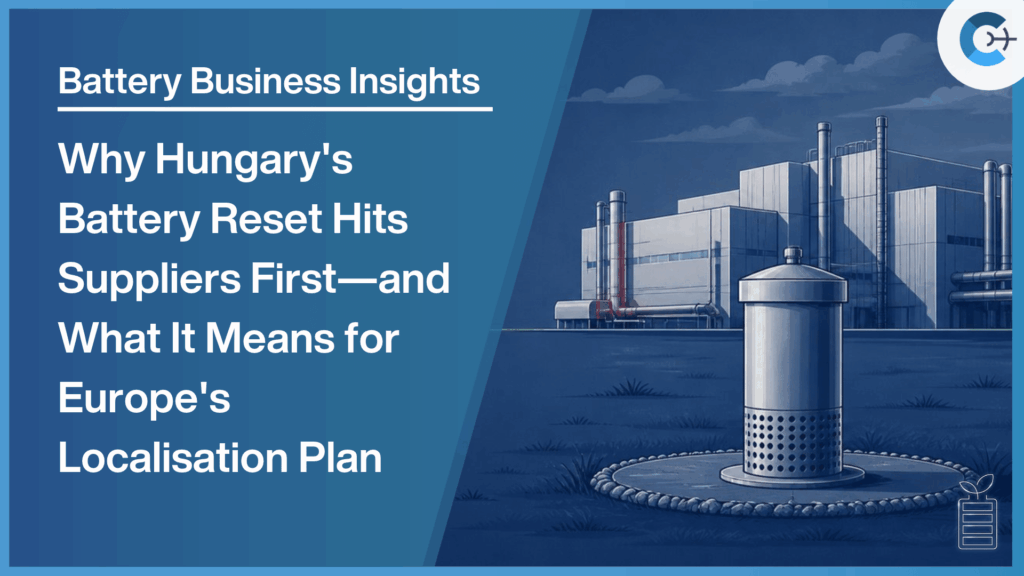

Hungary’s battery reset is stopping suppliers before it stops cell makers, and it changes the terms for every company that wants to build in Europe. On 18 October 2026, Interior Minister Gábor Pósfai announced that the country’s second-instance environmental authority had annulled the permit of Dongwha Electrolyte’s plant in Sóskút. Semcorp’s separator factory in Debrecen is entering its fifth month of shutdown (Bloomberg). Yet CATL says it began trial production in the same city on 22 September.
The picture is less dramatic than “battery production halted” and more lasting. In April, Benchmark expected Hungary to host 127 GWh of active cell capacity by the end of 2026, a forecast made before the inspections and CATL’s delay. What the new government has rewritten since then is the deal that brought those plants: the exemptions are gone, and the fines are set to grow.
By the Numbers: Hungary’s Battery Reset
- 127 GWh — Active cell capacity Benchmark forecast for Hungary at the end of 2026, in April, before the reset.
- About €26 billion — Battery investment in Hungary from 2021, mainly from China and South Korea, as reported by Hungarian Conservative.
- 40% and about 3% — Semcorp’s share of the world’s separator membranes, and the share of its designed capacity in the first phase of its Hungarian plant.
- 23,500 tonnes a year — Electrolyte output planned at Dongwha’s Sóskút plant without its own environmental impact assessment.
- 100 GWh — CATL’s planned Debrecen site, according to the company. Its first two lines are in trial operation, not series production.
- 5 billion forints — Planned maximum environmental fine, about $16 million.
- 0.5% of revenue — Planned minimum fine after three violations in five years.
- 61 fines, 405 million forints — Samsung SDI’s Göd record from 2018 to 2025, according to documents obtained by Átlátszó.
Timeline: From the April Election to the Sóskút Annulment
- 12 April: Péter Magyar’s Tisza party defeats Viktor Orbán’s Fidesz with a two-thirds majority.
- June: Mercedes-Benz confirms it sources VLE van batteries from China instead of Debrecen.
- 24 June and 3 July: Semcorp’s production is stopped, then all activity on site is banned.
- 1 August: A nationwide inspection of the battery industry begins.
- 16 August: The ministry withdraws the exemption for “key investment projects”.
- 19 and 25 August: CATL’s second phase is refused; its first phase is licensed the same day three workshops are stopped.
- September: Higher fines and a new authority are announced.
- 22 September: CATL starts trial production.
- 18 October: Dongwha’s permit annulment is announced.
- 30 October: Reuters reports the dismissal of a lawsuit against CATL’s plant.
Exemptions Built the Hub, and Small Fines Kept It Comfortable
According to Hungarian Conservative, the country attracted roughly €26 billion in battery investment from 2021, mainly from China and South Korea. Benchmark’s April forecast put only Poland ahead of it in cell output in the region. Part of the offer was procedural. “Key investment projects” were exempt from environmental, nature-conservation and urban-planning rules.
Enforcement barely registered. Documents obtained by the investigative outlet Átlátszó show Samsung SDI’s plant in Göd was fined 61 times between 2018 and 2025, for 405 million forints, or €1.14 million, in total. Spread over eight years at a major cell plant, that is a running cost, not a deterrent.
The Rules Have Changed, the Welcome Mostly Has Not
Looking came first. A nationwide inspection of the industry’s whole operational chain began on 1 August, Minister of the Living Environment László Gajdos announced. Inspectors compare what permits say with what plants actually do on capacity, materials, emissions, water use and waste. No results have been published yet.
Removing the shortcut came next. On 16 August, the Ministry of Transport and Investment said those projects would no longer be exempt, according to CarNewsChina. A violator may be barred from new construction permits for at least six months, and CATL, Samsung and SK On are among the first targeted.
Higher penalties are still a plan. Hungary intends to raise the maximum environmental fine to 5 billion forints and set a minimum of 0.5% of annual net revenue after three violations in five years. Prime Minister Magyar put that minimum at about 5 billion forints for Göd, many times what the plant paid in eight years. A new authority is meant to monitor battery plants and, according to electrive, could order production stops.
What has not been announced is an exit. The government intends to review the subsidies, approvals and state commitments behind BYD’s settlement, but it has not announced a fundamental withdrawal from economic cooperation with China.
Materials Makers Took the Direct Hits, Cell Makers Kept Moving
The direct hits so far fall on the materials layer. Semcorp makes separators, the thin membranes that keep a cell’s poles apart. Authorities ordered its Debrecen plant to stop production on 24 June and banned all activity on 3 July over fire safety. Aluminium near a leak point was reported at 2.676 million micrograms per litre against a limit of 200 (BigGo Finance); Semcorp said it was investigating.
Dongwha makes electrolyte, the liquid in which a cell’s ions move. The authority found that its planned 23,500 tonnes a year required its own environmental impact assessment and could not be added to an existing hazardous-waste permit. The company needs a new application, and Pósfai said the decision is not in itself a final closure. Nippon Paper will suspend its Vácrátót plant, which makes the anode additive CMC, at the end of December. It cites regulation alongside revised EV policies, slower EV growth and global competition, so the crackdown is only part of that story.
Cell making tells a different story. On 25 August, regulators stopped work in the laser-cutting, winding and cell-drying workshops of CATL’s Debrecen plant after nine employees showed raised nickel indicators. The second phase was refused on 19 August over incorrectly labelled buildings on the site plan, and CATL drew a 10-million-forint fine, according to CarNewsChina. Even so, CATL says trial production began on 22 September on its first two lines, which EV Powered rates at 34 GWh in testing, while electrive gives 40 GWh for the initial factory. Neither is series output, and the planned site is 100 GWh.
A Debrecen court then dismissed residents’ lawsuit, ruling that they had lost standing because the permit documentation had been revised, and found no violations in the permitting process (Reuters, citing Securities Times). That is not a verdict on the plant’s current environmental performance. No production stop was found for Samsung SDI or SK On. BYD, for its part, still plans mass production in Szeged in the fourth quarter, a year after the original date. Large cell projects can absorb a delay; a small supplier cannot absorb a lost permit as easily.
One Carmaker Has Rerouted, and No Line Stoppage Was Found
Documented customer effects are narrow. Mercedes-Benz sources the roughly 115 kWh battery packs for its VLE electric van from China instead of Debrecen, with CATL covering the additional costs, Mercedes Vans CEO Thomas Klein told Automobilwoche in June. The delay was reportedly due to pending approvals and stricter environmental rules. BMW is not affected, because its cell supply from Hungary is only scheduled to begin in 2027. No line stoppage was found.
Separators show why the effect stays hidden. Semcorp’s Hungarian first phase accounts for about 3% of its designed capacity, and a person close to the company said in July that customers could be supplied from other production bases. Supply survives that way, but not from the plant that was built to put it in Europe. How much of Europe depends on Hungary today is harder to say: Benchmark’s figure dates from April, and no current European share was found.
This is where Hungary stops being a Hungarian story. Officials in Brussels told Borderlex that a good outcome of the EU’s hybrid safeguard would be more Chinese car plants in Europe, plugged into European supply chains. Lilin Liang of the China Chamber of Commerce to the EU replied that Chinese companies would be “very hesitant to put billions and billions in Europe” unless high energy, labour and compliance costs are addressed. Hungary is now the live test of what those compliance costs are.
Residents and Compliant Operators Gain, Suppliers Pay First
- Gains: residents near the plants, because emissions and water use are now checked against the permit. Operators that already comply, and other European sites competing for the next project, are likely winners too, though no such shift has been documented.
- Pays: suppliers facing new permit procedures. Investors facing reviewed terms, with significant financial losses according to Hungary Today. Customers on longer supply routes, although in Mercedes’s case CATL bears the cost. Hungarian jobs and tax revenue if projects slow; no job figure was found.
A Necessary Risk?
Predictability is the case against the reset. Hungary Today reports questions in business circles about reliability, because retroactively revoked permits and suspended operations mean significant financial losses, and thousands of jobs depend on these investments. An investor who was promised one set of rules now faces another, and no named industry body was found on record about the cost.
Yet those promises were also the weakness. Dongwha’s permit fell on appeal over a defect in the first-instance review. Göd’s fines changed little. And the targets are not only Chinese: Dongwha and Samsung SDI are Korean, and Nippon Paper is Japanese. CATL’s court win shows a project can pass. Rules that survive an appeal are worth more to a long-term investor than an exemption that a change of government can remove.
Bottom Line
Hungary is not leaving the battery business. It is charging what the old terms left out. The next proof points are the inspection results, the new authority and the fine law, CATL’s step from trial to series production, and BYD’s fourth-quarter start. Brussels wants more plants of this kind. Whoever builds them will now price in the groundwater at Debrecen and the permit at Sóskút.
Battery Business Insights is an independent industry publication. Figures reflect the most recent data available at the publication date. The planned fines and the new authority were announcements at the time of writing; company figures are company-reported.
References: 444.hu; Hungary Today; Bloomberg via The Japan Times; CATL; Benchmark; Telex; CarNewsChina; Battery-News; electrive (September); electrive (June); BigGo Finance; EV Powered; Reuters; Átlátszó; Hungarian Conservative; Hungary Today (BYD); Borderlex