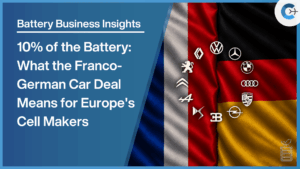

On 16 October 2026, France and Germany announced a joint approach to the future of the European car industry. They met on the sidelines of the European Council in Brussels, and their stated aim is that the cars of the future are produced in Europe. For batteries, the reported terms point the other way. According to Euronews, only 10% of battery content would have to come from European sources. European-made cells already met 48% of EV battery demand in early 2026 (Benchmark).
By the Numbers: A Battery Floor Below Today’s Market
- 90% — CO2 cut for new cars by 2035 against 2021, with no offset of the remaining 10%, as reported. (Reuters)
- 70% and 10% — Required European share of car components excluding batteries, and of battery content, as reported. (Euronews)
- 10%, then 20% — Share of battery cells to be sourced in Europe in 2028–2029 and 2030–2031, according to T&E.
- 3, then 5 components — EU-origin battery components required by the Commission’s proposal, cells from the start, cathode active material and the battery management system after three years.
- 48% — Share of EV battery demand met by European-made cells in the EU, EFTA and UK, January to April 2026. (Benchmark)
- 22% — Share of China-made EVs in EU EV sales in the first eight months of 2026, up from 17% in 2023.
- 23 November — European Parliament plenary vote on the CO2 proposal.
The Commission Made European Cells the Test
Two files set the frame. According to Reuters, the Commission had proposed that carmakers cut CO2 emissions by 90% against 2021 in 2035, with the remaining 10% offset through other measures. In March 2026 it added the Industrial Accelerator Act. That proposal links public procurement and public support for electric cars to Union origin, and the battery is at its core.
Under the proposal, a car qualifies only if it is assembled in the EU. At least 70% of its non-battery components by value must be of EU origin. Its traction battery must also contain at least three main components of EU origin, the battery cells among them. Three years after entry into force, that list grows to five. It then adds the cathode active material and the battery management system (BMS), the electronics that monitor and protect the cells. In the Commission’s text, a European car needs European cells.
The Statement Gives No Numbers, the Paper Does
The joint statement itself names no figures. It contains no CO2 percentage, no local-content share and no battery threshold, and speaks instead of a decarbonisation pathway, regulatory flexibility and incentives for European production. Every number comes from the Franco-German paper as reported. According to Reuters, the 2035 target would stay at 90% without the need for additional compensatory measures. The utility factor, which decides how far a plug-in hybrid counts as electric, would not be revised before 2030. “Made in EU” would also extend to former members of the internal market such as Britain, subject to full reciprocity.
The battery terms are thinner still. Euronews reports that 70% of car components excluding batteries would have to be produced in Europe, and 10% of battery content would have to come from European sources. Whether that 10% means cells, value or weight is not in the reports. Nor is it law: Euronews describes a joint national position that other member states and EU lawmakers must still decide whether to back. Reuters adds that a final common text is unlikely before early next year, so the battery line is the least settled part of the deal.
A Threshold Under 48% Adds No Demand for European Cells
T&E reads the paper as sourcing just 10% of battery cells in Europe in 2028–2029, rising to 20% in 2030–2031. That sits far below the Commission’s requirement of EU-origin cells. It also sits below the market. In the first four months of 2026, cells made in Europe met 48% of the battery demand of new EVs sold in the EU, EFTA and UK, against 47% for cells made in China (Benchmark). A floor below that share asks carmakers for nothing they do not already buy. It gives a gigafactory no reason to expect more orders. The advocacy group itself puts the European share at over 50% in 2025, and claims 164 GWh of capacity would be at risk in 2027 and 254 GWh in 2030.
Origin follows the factory, not the owner. Bruegel estimated that European cell plants could meet about two-thirds of domestic demand. It also found that LG Energy, SK Innovation and Samsung SDI own about four-fifths of operational European capacity, so a stricter rule would protect Korean-owned plants too. Meanwhile, imported cars keep gaining. China-made EVs took 22% of EU EV sales in the first eight months of 2026, up from 17% in 2023. Toyota’s European division says its current battery production study would benefit from including more trusted partners. For investors, the partner list may matter as much as the percentage.
Supporters Call It a Pro-Investment Signal
The case for the deal is about plants and jobs. Chancellor Friedrich Merz called it “a good day for motorists and for jobs in Germany, France and Europe.” Finance minister Lars Klingbeil said, “We do not want Germany to merely assemble components from Asia.” An Élysée source told Euronews that the European preference should keep factories from becoming mere assembly plants. Lower Saxony’s premier Olaf Lies sees the deal strengthening future markets such as batteries and green steel. Renault’s chief executive François Provost puts the Chinese cost advantage at 30% to 40%, and Volkswagen and Stellantis welcomed the agreement. T&E’s Anna Krajinska answered that it “takes the teeth out of the Industrial Accelerator Act.”
Bottom Line
Paris and Berlin want the cars of the future made in Europe. Yet the battery line in their paper sits below what European plants already supply. That figure will be settled in Brussels, not in the two capitals. MEPs vote on the CO2 proposal on 23 November, and other member states still have to back the plan. For cell makers, the test of that vote is simple: a floor under today’s market share protects nothing new.
Battery Business Insights is an independent industry publication. Figures reflect the most recent data available at the publication date. The Franco-German terms are reported from a paper that has not been published; the joint statement contains no figures.
References: Élysée; Reuters; Euronews; T&E; European Commission; Benchmark; Bruegel.