

Founded in 2022 as a spin-off from RWTH Aachen University, cylib is positioning itself as Europe’s go-to industrial partner for closing the battery materials loop. The company transforms end-of-life lithium-ion batteries, production scrap, and black mass into battery-grade raw materials — primarily lithium, graphite, nickel, cobalt, and manganese — using a proprietary, water-based process that achieves over 90% recycling efficiency and delivers an 80% reduction in carbon footprint compared to primary extraction.
With the construction of its first industrial facility underway at CHEMPARK Dormagen, backed by more than €140 million in equity and grants, cylib is building real infrastructure at a moment when Europe urgently needs domestic battery material supply chains. Its record as the first company in Europe to qualify recycled lithium carbonate for new EV battery production — and to produce battery-grade lithium hydroxide from spent EV cells — sets it apart from the broader field of recycling startups still operating at bench scale.
Key Facts & Figures
- Founded: 2022
- Headquarters: Aachen, Germany (+ Dormagen facility)
- Employees:120+
- Total Funding: €140M+ (equity and grants)
- Series A: €55M (May 2024, co-led by World Fund and Porsche Ventures)
- Key Grants: €26.1M (EU/ERDF, Sept 2025) + €63.4M (STARK, Dec 2025)
- Planned Capacity: 60,000 t/yr (~140,000 EV batteries) at Dormagen from 2027
- Recycling Efficiency: >90% for Li, graphite, Ni, Co, Mn
- Carbon Savings: 80% lower GHG vs. primary extraction
- Certifications: ISO 9001, ISO 14001, ISO 50001
- Products: cylium® (lithium), cygraph® (graphite)
Company Background & Market Position
Cylib was co-founded by Dr. Lilian Schwich (Co-CEO), Paul Sabarny (CTO), and Dr. Gideon Schwich, all emerging from research conducted at RWTH Aachen University. The founding team built the company on an explicit thesis: industrial-scale battery recycling infrastructure needs to be in place before the wave of end-of-life EV batteries arrives, not after.
From a €3.6 million seed round in October 2022, cylib grew rapidly, closing a €55 million Series A in May 2024 — the largest Series A ever raised by a German battery recycling company at the time — with co-leads World Fund and Porsche Ventures, and participation from Bosch Ventures. Total capital raised, including grants, now exceeds €140 million.
Operating today from its pilot facility in Aachen with 120+ employees, cylib serves automotive Tier 1 suppliers, battery manufacturers, and chemical industry partners. Its partnership with Webasto (formalized March 2025) and its MOU with Pure Battery Technologies (June 2025) for black mass concentrate supply illustrate a growing commercial network across the European battery value chain. Dr. Lilian Schwich received the Nicolaus August Otto Award 2025 for innovation, and cylib was listed in the Norrsken Impact/100 in 2023.
Interview with Cylib’s Co-Founders and CEOs Lilian and Gideon Schwich
In the recent BetterE Podcast hosted by our colleague Simon Voss (BetterE Expedition), Cylib co-founders and CEOs Lilian Schwich and Gideon Schwich laid out what it takes to close the loop for lithium-ion batteries—technically, financially, and operationally. The conversation connects lab-built process innovation with the realities of building a recycling plant in Germany.
Schwich came into the sector through research on recycling and metal recovery, driven by the impact of raw material extraction on the global environmental footprint. Gideon Schwich approached it from the economic and societal side: the energy transition had been on his mind for a decade, and meeting Lilian made the role of recycling in that transition hard to ignore. Their founding story is distinctly academic: a strong lab result, a realization that existing industrial processes were not meeting the moment, and then the tougher question of whether the technology had a durable business case.
That business case has shifted with commodity cycles. As Gideon noted, early planning in 2021–2022 coincided with a very different lithium price environment. Even now, the opportunity remains, but tighter margins raise the importance of partnerships, interfaces along the value chain, and regulatory clarity—down to questions like whether Europe will restrict black mass exports.
On the technology side, Cylib’s pitch is an end-to-end recycling process that can take battery packs, modules, and production scrap and return separated raw materials with consistent quality. Their core IP combines thermal pre-treatment with a hydrometallurgical process designed to reduce chemical inputs. As Lilian put it, “we recover lithium and graphite using only water,” aiming to improve both economics and process footprint.
Scaling is where strategy meets infrastructure. Cylib is moving from Aachen to Chempark Dormagen to support industrial throughput—Gideon described a target of 10,000 tons per year of black mass input, roughly equivalent to about 30,000 tons of packs or 60,000–70,000 EVs per year. Lilian also pointed to improving permitting experience at scale and announced “a grant of more than 26 million euros” from North Rhine-Westphalia in cooperation with the EU.
Manufacturing Capacity & Infrastructure
Cylib broke ground at CHEMPARK Dormagen in September 2024, constructing a 236,000 sq ft (22,000 m²) industrial facility designed to become Europe’s most capable battery recycling plant. The site is being built in two complementary lines:
- NMC line: 30,000 tonnes per year, targeting nickel-manganese-cobalt batteries
- LFP line: 30,000 tonnes per year, becoming Europe’s first industrial-scale LFP recycling line, funded by a €63.4 million grant from Germany’s Federal Ministry for Economic Affairs and Climate Action under the STARK structural transition programme (announced December 2025)
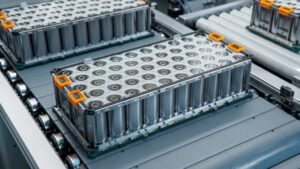
At full capacity, the Dormagen site will process 60,000 tonnes of battery material annually, the equivalent of approximately 140,000 EV batteries per year. Operations are scheduled to begin in 2027.
Earlier, a €26.1 million EU grant (European Regional Development Fund and Just Transition Fund, confirmed September 2025) supported the initial NMC build-out phase. The facility uses closed-loop water systems, is powered by 100% renewable electricity, and is fully compliant with EU Battery Regulation requirements. An ongoing automation project, AuBa@C, is integrating collaborative robotics into battery disassembly workflows to support throughput and worker safety at industrial scale.
Cylib currently operates a pilot plant in Aachen, where it has already produced and qualified battery-grade materials — the commercial and technological foundation that the Dormagen scale-up is built on.
Technology & Product Portfolio
Cylib’s core intellectual property is its OLiC (Optimised Lithium and Graphite Recovery) process, a water-based hydrometallurgical method that processes battery packs, production scrap, and black mass end-to-end — from discharging and disassembly through to refined, market-ready materials. The process deliberately avoids pyrometallurgy and minimizes chemical inputs, enabling a substantially cleaner carbon profile.
Products currently produced and qualified:
- cylium® — high-purity lithium compounds, including lithium carbonate (Li₂CO₃) and lithium hydroxide (LiOH). In January 2026, cylib announced that its recycled lithium carbonate had been qualified by an international battery manufacturer and is now being used in the production of new EV batteries — a significant commercial milestone for any recycling company. In July 2025, cylib and Syensqo reached a milestone producing battery-grade lithium hydroxide from spent EV cells, using Syensqo’s CYANEX® 936P solvent extraction technology to maximize lithium purity from mixed chemistry streams.
- cygraph® — battery-grade graphite, available in multiple grades customized to partner specifications, recovered alongside lithium in the same integrated process.
- Nickel, cobalt, and manganese compounds are also recovered from the hydrometallurgical extraction steps and supplied to customer specification.
All cylib products are designed to be reintroduced directly into battery manufacturing, creating a genuine closed-loop supply chain. The company holds ISO 9001, ISO 14001, and ISO 50001 certifications, and operates as a certified waste management company under German law.
A separate collaboration with High Performance Battery (HPB) is evaluating the recyclability of next-generation solid-state battery chemistries through cylib’s process, signaling early-stage readiness for emerging cell technologies.
Renew.
Strategic Initiatives & Market Context
The timing of cylib’s industrialization trajectory aligns directly with intensifying regulatory pressure across Europe. The EU Battery Regulation mandates increasing recovery rates for lithium, cobalt, nickel, and other materials from 2027 onward, while stipulating minimum recycled content requirements for new batteries from 2030. Cylib describes itself as already meeting current regulation requirements — a positioning advantage as compliance timelines compress.
In April 2026, cylib joined the SIB:DE consortium, a 25-partner German initiative backed by €14.5 million from the Federal Ministry of Research and Technology (BMFTR), running from March 2026 to February 2029. The project aims to develop Europe’s first industrial recycling process for sodium-ion batteries, an emerging chemistry gaining commercial traction. Consortium members include battery producers VARTA and EAS Batteries, electrolyte specialist E-Lyte Innovations, machinery companies GROB-WERKE and Coperion, and eight Fraunhofer Institutes alongside RWTH Aachen. Cylib leads the recycling track, continuing its pattern of entering next-generation battery value chains before volume demand materializes.
Across its operations, cylib runs on 100% renewable electricity and has had its 80% carbon savings over primary extraction verified through an independent lifecycle assessment (LCA, 2023).
Future Outlook & Final Perspective
Cylib’s trajectory from a 2022 university spin-off to a company managing over €140 million in capital and constructing Europe’s first combined NMC and LFP industrial recycling plant in under four years is notable by any measure in the capital-intensive battery sector.
The 2027 Dormagen startup date is the next significant test. Converting construction progress into reliable throughput at 60,000 tonnes per year — across two distinct battery chemistries — while qualifying output materials for demanding automotive and battery manufacturing customers will define whether cylib’s operational capabilities match its financial and institutional backing.
Several structural forces work in its favor: rising EU regulatory mandates, growing automaker demand for domestic material supply chains, and an established commercial pipeline through partnerships with Webasto, Syensqo, Pure Battery Technologies, and an undisclosed major battery manufacturer that already qualified cylib’s lithium carbonate. The addition of sodium-ion battery recycling R&D through SIB:DE extends the company’s technical relevance beyond the current lithium-ion wave.
For investors, procurement officers, and policymakers tracking where Europe’s battery raw material base will actually come from, cylib represents one of the clearest answers currently under construction.