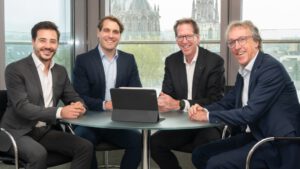

A German cell maker has reached series production, and it is betting on special cells, not volume. UniverCell officially opened its production site in Kiel-Moorsee on 9 November 2026, with Schleswig-Holstein’s Minister-President Daniel Günther and Economy Minister Claus Ruhe Madsen among the guests. The plant is to make cylindrical 21700 cells in series, with a capacity of up to 40 million cells a year, according to the company.
The 21700 is a standard round cell format, named after its size. What makes the Kiel plant worth a closer look is not its size but its route. China holds over 80% of global battery cell manufacturing capacity and the EU 6-7% (IEA). UniverCell is trying to add to the EU’s share from the top of the market down: customised cells for demanding applications, its own electrodes, and financing one step at a time.
By the Numbers: UniverCell’s Step Into Series Production
- 9 November 2026 — Official opening of the Kiel-Moorsee site for series production of 21700 cells, according to UniverCell.
- Up to 40 million cells a year — Capacity of the new site, which UniverCell says later stages can raise to more than 150 million.
- Up to €300 million — Investment UniverCell plans at Kiel-Moorsee in the coming years.
- More than 200 — New jobs planned in production, R&D, engineering, quality and administration, according to the company.
- €30 million — Series B round closed in March 2026, with the DeepTech & Climate Fonds and the EIC Fund.
- 2019 — Year Stefan Permien and Marius Strack founded UniverCell.
Seven Years From Electrode Foil to a Series Line
Stefan Permien and Marius Strack founded UniverCell in 2019 to develop and produce cells for demanding special applications, according to the company, with customised cells rather than standard mass products. Production started with electrodes: UniverCell has made electrode foils since November 2020, and it makes all of its anodes and cathodes in-house. At its Flintbek site it also developed pouch cells and the 21700 cell that the new plant is built for.
Its customers sit at the expensive end of the market. UniverCell’s cells go into satellites, space systems and medical intensive-care devices, and for its 21700 cell the company lists power tools, e-mobility, e-aviation and aerospace. The company reported revenue in the double-digit millions of euros for the previous year. The founders chose against a joint venture with Chinese companies. The business was built on small, demanding orders, not on a single anchor customer.
Kiel-Moorsee Adds Series Capacity Next to Flintbek
The new site complements Flintbek, where UniverCell keeps its headquarters, electrode production and development work. Kiel-Moorsee is for series cells. Its capacity is up to 40 million cells a year, and UniverCell says later stages can raise it to more than 150 million.
Earlier figures were plans. In March, UniverCell planned to make 50,000 cells a month from June, and co-founder Permien said annual capacity could reach about 1.3 gigawatt hours by 2027. The company’s website even states that the gigafactory is ready to scale beyond 1.5 GWh. At the opening, Permien said it all began seven years ago with the idea of building modern cell production in Germany, and that production is now running in Kiel-Moorsee. The plant is open; how many cells leave it is the next number to watch.
Tabless Cells and Dry Coating Are UniverCell’s Technical Edge
Two features carry the company’s technical case. Its 21700 cell has a tabless design, in which current leaves the electrode along its whole edge rather than through a single strip of foil, which the company says lowers internal resistance and heat. UniverCell pairs it with what it calls a patented cylindrical-cell architecture and claims a market-leading gravimetric energy density, meaning energy per kilogram.
The second is dry electrode coating, in which the electrode is made from powder instead of a wet slurry that has to be dried in a long oven. UniverCell names its industrial dry-coating process as its technological edge and says it significantly reduces energy use, chemicals and CO2 emissions compared with wet coating.
€30 Million Raised, Up to €300 Million Planned at the Site
The expansion rests on a €30 million Series B round with the European Innovation Council and the DeepTech & Climate Fonds, which UniverCell says paved the way for the new capacity earlier in 2026. BTN covered the round when it closed.
The plan at the new site is far larger: up to €300 million in the coming years and more than 200 jobs. The politics are supportive. Günther said UniverCell shows that battery cells from Europe are possible in Schleswig-Holstein, that the state’s renewable power makes it the right location and that Europe needs its own cell production to become more independent. A growing cell maker has the state government behind it.
Customers and Output Will Decide Whether the Niche Route Works
Four things will show whether the opening becomes a business at scale. The first is a named customer for the 21700 line. The second is output against the capacity of up to 40 million cells. The third is how the €300 million plan is financed, and the fourth is how fast the 200 jobs are filled.
For the wider industry, the case is about route, not size. UniverCell’s path is high-value niches first, electrodes and cells under one roof, and capital raised as each step is reached. In this publication’s view, that path will not change the EU’s share of global capacity soon, but it can give European equipment and materials suppliers a customer close to home.
Bottom Line
UniverCell’s opening is a first step. It is not Europe’s answer on volume, and it does not claim to be. It is a small German cell maker reaching series production by serving customers who pay for special cells. The next test is not the opening but the first customer and the first output figure from Kiel-Moorsee.
Battery Business Insights is an independent industry publication. All specifications cited reflect company-reported data as of the publication date. Independent third-party verification of cell-level performance figures has not been confirmed at time of writing.
References: UniverCell (opening); UniverCell (company); UniverCell (21700 cell); Trending Topics; IEA