
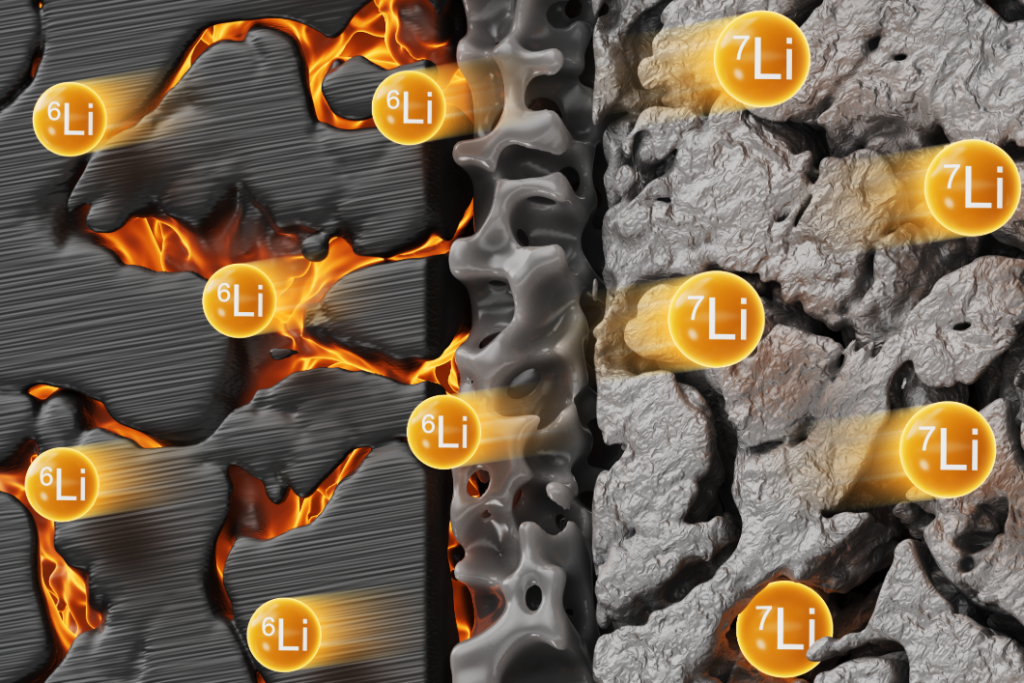

Researchers at the Federal Institute for Materials Research and Testing (BAM) have identified the distribution of lithium isotopes inside a cell as a new diagnostic marker for aging in lithium-ion batteries. The work, published in ACS Energy Letters, shows that the spatial distribution of lithium-6 and lithium-7 can provide a characteristic fingerprint of degradation processes and help distinguish how batteries are aging.
Lithium-ion batteries remain essential to the energy transition, but their service life is limited by complex aging mechanisms that are often difficult to separate using conventional methods. While standard diagnostics can confirm that a battery is degrading, they usually provide limited insight into when the degradation begins, where it occurs, or which mechanism is responsible. BAM researchers led by Carlos Abad and Beatrice Battistella sought to address that gap by tracking isotopes rather than focusing only on overall capacity loss.
Natural lithium consists mainly of two isotopes: lithium-6 and lithium-7. In new cells, their proportions match natural lithium deposits, with about 2.4% lithium-6 and 97.6% lithium-7. The team studied lithium-ion batteries with an NMC cathode and a graphite anode and found that after the first few charging cycles, lithium-6 began to accumulate preferentially at the anode. After an additional 280 cycles, the effect became more pronounced, while the cathode showed higher levels of lithium-7. At the same time, the batteries’ capacity declined.
The measurements were enabled by high-resolution mass spectrometry that allowed the researchers to map lithium isotopes layer by layer across the full depth of the electrodes. The study was carried out in collaboration with Nu Instruments Ltd. in the United Kingdom and the Leibniz Institute for Solid State and Materials Research Dresden (IFW Dresden).
According to the researchers, the isotope patterns act as natural markers that reflect lithium movement during battery operation and reveal where changes take place inside the cell. They said the findings could support earlier tracking of aging, allowing degradation to be detected before major capacity loss occurs. In the longer term, the approach could help improve understanding of aging mechanisms, support targeted battery optimization, and enable more accurate predictions of service life.
Source: BAM