

China’s automaker BYD has introduced the “HaoHan,” a direct-current energy storage system featuring the largest single-unit capacity available today at 14.5 MWh. Unveiled on September 18 at the International Digital Energy Expo in Shenzhen, the HaoHan block doubles the typical industry unit size of 6–7 MWh.
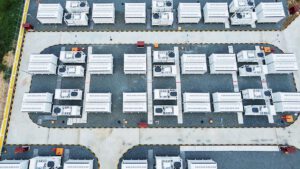
When installed in a standard 20-foot container, the system delivers 10 MWh and achieves a volumetric energy density of 233 kWh per cubic meter—51% higher than the market average. BYD estimates that a 1 GWh energy storage plant using HaoHan units would require fewer than half the number of blocks, reduce land use by one-third, and cut the total cell count by 76% compared with conventional designs.
Central to the system is BYD’s proprietary 2,710 Ah Blade Battery cell, which the company describes as the largest energy storage cell in production. This cell offers three times the capacity of conventional alternatives, supports more than 10,000 charge-discharge cycles, and lowers lifecycle costs to under CNY 0.1 per kWh. By leveraging an integrated cell-to-system architecture, the system reaches a volumetric cell-to-system efficiency of 52%, reducing redundant components and boosting energy density.
Engineered for environments ranging from deserts to coastal regions, the HaoHan system employs ruggedized hardware and optimized thermal management to cut failure rates and maintenance expenses by 70%. Coupled with BYD’s in-house power conversion solution and advanced energy management software, the unit delivers millisecond-level response times and grid-forming capabilities at gigawatt scale.
BYD projects that the HaoHan system can lower project-level levelized cost of storage by 21.7%, and reduce procurement, transport, and installation expenses by roughly 30% for a 1 GWh installation. Target applications include grid balancing, renewable energy integration at solar and wind farms, and backup power for commercial and residential facilities. HaoHan also features a blockchain-based carbon tracking module that cuts lifecycle emissions by 18%, aiding compliance with emerging environmental regulations.
Looking ahead, BYD plans multiple gigawatt-scale deployments by the end of 2025, including a landmark 12.5 GWh project in Saudi Arabia, and is expanding its footprint in Europe, Latin America, Africa, and Southeast Asia. On its technology roadmap are liquid cooling, predictive maintenance, and hybrid solar-hydrogen storage, with the goal of exceeding 95% overall system efficiency by 2026. The company also introduced its GC Flux grid-forming inverter (2.5–10 MW range) and the GC Master EMS platform for intelligent scheduling and control of ultra-large installations.
Source: ESS News