

Welcome back to this week’s Battery Business Insights article. The story this week is one the numbers tell loud and clear: AI is no longer just stressing the US power grid — it is actively reshaping who builds what, where, and how fast. On May 21, the Solar Energy Industries Association (SEIA) and Benchmark Mineral Intelligence published their latest US Energy Storage Market Outlook, reporting the strongest first quarter on record for American energy storage. That milestone arrived against a backdrop of colliding pressures — surging AI data center power demand, strained grid infrastructure, hyperscalers racing to secure 24/7 clean power, and a battery industry scrambling to scale fast enough to meet all of it. Whether you focus on megawatt-hours deployed, dollars invested, or deals signed, the signal is consistent: energy storage has moved from a useful grid accessory to something closer to mandatory infrastructure in the age of AI.
US Battery Storage — Record Q1 2026 and the $100B Trajectory
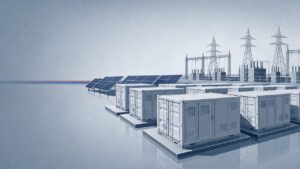
The US energy storage market opened 2026 with its strongest first quarter ever. SEIA and Benchmark Mineral Intelligence now project storage deployments to nearly quadruple by 2030, backed by $100 billion in sector investment.
The Scale of the AI-Driven Storage Surge
- 9.7 GWh of new energy storage was installed in the US in Q1 2026 — a record for any first quarter, up 32% year-over-year. Utility-scale batteries alone contributed 7.8 GWh. (SEIA/Benchmark, May 2026)
- Full-year 2025 set the previous annual record: 57.6 GWh added, bringing total US deployed capacity to 166.1 GWh. That was a 52% increase over 2024. (SEIA, May 2026)
- SEIA now forecasts more than 610 GWh of cumulative US storage installations by 2030, with an internal whitepaper target as high as 700 GWh. Annual deployments are expected to reach 110 GWh by 2030. (SEIA/Benchmark, May 2026)
- AI data center power demand could account for 9%–17% of total US electricity consumption by 2030, or up to 790 TWh — more than double current data center demand. (EPRI, via Reuters, May 2026)
- US data centers consumed 183 TWh in 2024 (~4% of US supply). That is projected to reach 426 TWh by 2030, a 133% jump in six years. (IEA, via Pew Research, October 2025)
- US data center power capacity is expected to grow from roughly 30 GW today to 90 GW or more by 2030 — a 22% annual growth rate. (Industry projections, January 2026)
- Battery storage now accounts for 28% (24.3 GW) of all planned 2026 US capacity additions, ranking as the second-largest source of new grid infrastructure behind solar. (PV Magazine USA, April 2026)
- The US energy sector is on course to invest $100 billion in battery storage by 2030. (American Clean Power Association, May 2026)
- Global non-pumped-hydro storage reached 112 GW in 2025; BloombergNEF forecasts a 41% increase in 2026 alone. (Energy Storage Summit USA 2026)
How AI and Storage Became Inseparable
For most of the past decade, grid-scale battery storage grew steadily as a tool to manage renewable intermittency. Solar panels flood the grid at midday; batteries absorb the surplus and release it in the evening. That arbitrage logic drove California’s early dominance in storage deployment and has since spread across Texas, Arizona, and beyond.
What changed around 2022 was the arrival of a fundamentally different kind of electricity demand. AI data centers do not follow predictable daily curves. They run continuously, at enormous scale, and their compute workloads — particularly large-model training and inference — create what FlexGen’s Jason Abiecunas described in late 2025 as “intense power fluctuations unlike anything we’ve seen in cloud data centers previously.” A single facility can draw hundreds of megawatts and swing that load rapidly as workloads shift. Standard grid infrastructure, designed for slower-moving industrial and residential demand, was not built for this. Neither, critically, were the diesel backup generators that data centers have historically used for resilience.
The result is a demand profile that batteries are uniquely suited to manage. Short-duration lithium-ion systems can absorb rapid swings that gas generators cannot track quickly enough. On the clean-energy side, hyperscalers’ public commitments to 24/7 carbon-free power create a structural need to pair intermittent wind and solar with storage that can firm output around the clock. By 2025, both of those dynamics — AI load volatility and clean-power commitments — were pulling significant capital toward energy storage simultaneously.
Deals, Utilities, and Policy in Motion
The most striking signal of where the market is heading came not from a quarterly report but from a factory floor in West Virginia. At CERAWeek in Houston on March 24, 2026, Form Energy — whose iron-air batteries can store energy for 100 hours at less than one-tenth the cost of lithium-ion — signed a 12 GWh supply agreement with Crusoe, an AI data center infrastructure developer, with deliveries beginning in 2027. That deal came weeks after Canary Media reported Form’s even larger partnership with Xcel Energy and Google: a 300 MW / 30 GWh iron-air system, roughly 100 hours of duration, to power a new Google data center in Minnesota. Xcel CEO Bob Frenzel called the structure — where Google covers all incremental infrastructure costs in exchange for a long-term clean-energy supply of 1.9 GW — a template for large-load tariffs it will replicate in Colorado, Texas, New Mexico, and Wisconsin. It is, to date, the largest planned battery project in the world by energy capacity.
Form Energy — Iron-Air Storage at Gigawatt-Hour Scale
Long-duration iron-air storage has exited the pilot phase. Form Energy has secured two of the largest battery deals in the world and now owns the leading commercial position for 100-hour energy coverage.
On the utility side, incumbent electric companies are staring at demand pipelines they have not seen in a generation. DTE Energy disclosed in its Q1 2026 earnings call that it is preparing to serve a 1.4 GW Oracle data center in Michigan, has a 1 GW Google data center deal filed with state regulators, and sees a potential 8.4 GW pipeline of data center projects across its service territory. NextEra Energy Resources contracted a record 4 GW of new generation in Q1 2026 alone — including 1.3 GW of battery storage — and markets itself explicitly to data center “hub” developers across the country. Storage integrators are moving fast to match. Fluence CEO Julian Nebreda said his company is engaged in over 30 GWh of data center storage projects globally. Tesla generated $430 million in storage revenue last year from systems supplied to xAI.
Regulators are attempting to keep up. FERC is developing frameworks to allow co-located load and generation interconnection requests — a process that could compress study timelines for storage projects paired with new data center loads. In Virginia, the state with the densest concentration of data centers in the country, SB 508 now directs utilities to establish pilot programs for storage and solar facilities that tap surplus interconnection service — letting new projects connect using existing, underutilized grid rights rather than waiting in a queue for new capacity.
Why Storage Is Not the Only Answer — and Why That Matters
The storage boom is real. But treating it as a clean-cut victory for batteries over fossil fuels would miss an important counter-current running through the same data. Natural gas is making a comeback in US capacity planning, and AI is the reason.
Natural Gas vs. Battery Storage — The Structural Picture
Natural gas is winning on interconnection speed and cost. Battery storage is winning on share, flexibility, and the only role gas turbines cannot fill: millisecond-scale load following. The near-term answer is coexistence, not displacement.
In 2024, natural gas represented just 11.1% of planned US capacity additions. By 2026, that share had rebounded to 18.1%, while solar’s share slipped from 51% to 45.6% and non-renewable planned additions jumped 71% in a single year, according to the American Action Forum. The IEA projects that natural gas will remain the single largest source of US data center electricity through 2030, even as renewables grow. It supplied more than 40% of data center power in 2024. The reason is structural, not ideological: grid interconnection for solar costs an average of approximately $253/kW versus roughly $24/kW for gas — more than a 10:1 gap. In data-center-heavy regions like Northern Virginia or ERCOT’s western zones, utilities offering speed and reliability to AI tenants often find that a new gas plant wins on timeline even when a renewables-plus-storage project would win on long-run cost.
That creates a genuine tension. The same AI demand wave that is funding storage deployment is also pulling utilities back toward dispatchable gas. Wood Mackenzie’s Ben Hertz-Shargel put the battery case precisely: “Batteries will be an essential resource at data centers reliant on onsite gas generation, as gas generators are not fast enough to follow volatile AI data center demand.” The near-term picture is probably not gas versus storage, but gas and storage coexisting — with storage managing the load volatility that gas turbines cannot handle at millisecond timescales. Whether batteries eventually displace gas as costs fall and grid infrastructure catches up remains the central long-run question for this market.
There is also a consumer cost dimension that regulators are beginning to take seriously. Carnegie Mellon research estimates that data center and crypto mining load growth could raise the average US electricity bill by 8% by 2030, with increases topping 25% in central and northern Virginia. Benchmark Mineral Intelligence’s Shan Tomouk said in the May 2026 SEIA report that “a supportive policy landscape for battery energy storage systems will be crucial to enabling the rollout of AI and data centers, while mitigating adverse cost impacts to regular consumers.” Storage, in that framing, is not just an asset for data center operators — it is the tool regulators expect to absorb AI load growth without forcing rate increases onto residential customers.
Beyond Lithium-Ion: The Technology Race AI Is Funding
The majority of US storage deployed today is 2-to-4-hour lithium-ion, which covers peak shaving and short-duration grid services well. But AI data centers running 24/7 clean power strategies need something else — the ability to bridge multi-day periods when solar and wind output is low. That requirement is pulling long-duration energy storage out of pilot projects and into commercial scale.
Beyond Lithium-Ion — The Long-Duration Race & Two Structural Headwinds
Most US storage deployed today is 2–4 hour lithium-ion. New chemistries are unlocking multi-day energy coverage — but two structural bottlenecks still determine how fast they reach the grid.
Form Energy’s iron-air technology is the clearest current example. By converting iron into rust during charging and reversing that reaction to generate electricity during discharge, the system can deliver 100 or more hours of continuous output. The company claims storage costs below one-tenth of lithium-ion on an energy basis, with no risk of thermal runaway. With more than 75 GWh of commercial projects under agreement and a factory running in Weirton, West Virginia, Form represents a new category of US-made, long-duration storage explicitly designed around the needs of data center operators seeking multi-day energy coverage. Vanadium flow batteries, compressed air, and thermal storage are also active development paths, though none has yet demonstrated Form’s commercial scale in the data center context.
Battery storage firms, meanwhile, face two structural headwinds that the deal pipeline alone does not resolve. Grid interconnection queues remain a multi-year bottleneck at most major RTOs and ISOs. Projects co-located with solar or wind inherit the generation queue’s delays, which can push energization dates four to seven years out — far longer than the two-to-four years a hyperscaler typically takes to build a campus. Supply chain dependence on China compounds this. Chinese manufacturers dominate production of LFP battery cells, cathode materials, and key precursors, and ongoing tariff uncertainty creates procurement and bankability risks for projects that need firm pricing over multi-year development windows. US domestic manufacturing is expanding — LG Energy Solution and others are building out capacity in Michigan and elsewhere — but the ramp is not yet fast enough to insulate large US storage projects from Chinese supply dynamics.
What’s Next: A Structural Shift With Unresolved Questions
The trajectory from here is likely upward for storage, even accounting for the headwinds. UBS Securities projected in late 2025 that global energy storage demand would rise 40% year-on-year in 2026, driven primarily by AI data center load growth in the US. SEIA’s 610–700 GWh US deployment forecast by 2030 would represent nearly quadrupling the current installed base in four years. The 13 states that now have explicit storage targets, combined with IRA tax credit support for standalone storage and growing corporate demand from hyperscalers, create a durable floor under the market even if the pace varies.
What remains genuinely uncertain is how much of AI’s power demand ends up served by clean storage-firmed renewables versus new gas. The structural cost advantage gas holds in interconnection — and the speed advantage it holds in permitting — means the near-term answer in most regions will be “both.” Longer term, the economics of iron-air and other long-duration chemistries, if they deliver on cost promises at commercial scale, could shift that balance significantly. A 100-hour iron-air system paired with solar and wind can, in principle, provide around-the-clock firm power to a data center without gas backup. The Google-Xcel-Form project in Minnesota is effectively a real-world test of whether that works at gigawatt-hour scale.
Policy speed will matter enormously. The interconnection queue problem is not a technology problem — it is a regulatory process problem. FERC’s move toward co-located load and generation frameworks is a step in the right direction, but the rulemaking timelines are measured in years, not months. States that act faster — Virginia’s surplus interconnection pilot is one model — will attract data center investment and storage deployment ahead of those waiting for federal resolution. The geographic concentration of the current boom in Texas, Arizona, and California is partly a reflection of which grid operators have already cleared more of those regulatory hurdles.
Bottom Line
The record US storage installations in Q1 2026 are not a coincidence. They reflect a new structural reality: AI data centers have created a category of electricity demand that the existing grid was not built to serve, and batteries are often the fastest, most flexible answer available. The investment flows—$100 billion targeted by 2030, deals scaling into the tens of GWh for single projects—confirm that both corporate buyers and utilities believe storage is now core infrastructure. The open question is not whether storage will grow alongside AI, but how quickly the regulatory and supply chain bottlenecks can be resolved to let it grow fast enough to keep gas from locking in a larger role than the clean-energy math would otherwise justify.
Battery Business Insights article covers the global battery industry and energy storage sector. All claims in this article are sourced from verified reporting by Reuters, SEIA, American Clean Power Association, Form Energy, Utility Dive, PV Magazine USA, Pew Research, Electrek, American Action Forum, Energy Storage News, and the Economic Times, published between October 2025 and May 2026.