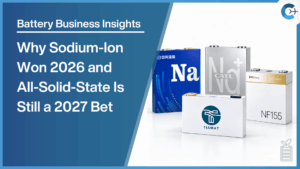


Welcome back to this week’s Battery Business Insights article on one of the most closely watched battery technology transitions happening right now. Sodium-ion has been promising to arrive commercially for several years, and the first half of 2026 has brought the clearest evidence yet that it is doing exactly that. At the center of this week’s coverage is Gotion High-Tech, the Volkswagen-backed Chinese battery manufacturer that unveiled its dedicated sodium-ion platform — branded Gnascent — at its 15th Global Technology Conference on May 17, 2026. This isn’t a single cell product but a family of three application-specific variants, each targeting a distinct market. The launch matters for two reasons: the technical specs being claimed are among the highest ever publicly announced for sodium-ion, and existing GWh-scale production infrastructure in China is already behind it.
What Gotion’s Gnascent Platform Delivers
- 261 Wh/kg — cell energy density of the Gnascent High-Energy variant, the company reports as approximately 60% above traditional sodium-ion cells
- 162 Wh/kg — energy density of the Power variant, capable of discharge down to –50°C
- 180 Ah — single-cell capacity of the Energy Storage variant, with a claimed cycle life exceeding 20,000 charge-discharge cycles
- 88% — reported capacity retention of the Energy Storage variant at –40°C
- 400°C — continuous heating temperature the Energy Storage variant withstands without ignition; passed 8 mm steel nail penetration test without fire
- 90+ — patents underpinning the Gnascent technology platform
- 2 GWh-scale plants — production lines already in operation in Tangshan and Hefei, China
- Q4 2026 — targeted date for large-scale mass production of the Energy Storage variant
- 400 GWh — Gotion’s total reported energy storage capacity across 20 global manufacturing bases as of end-2025
- 4.05 GWh — Gotion’s installed power battery capacity in China in April 2026; 6.6% market share in China, ranking 3rd behind CATL and BYD
How Sodium-Ion Got Here
Sodium-ion battery research stretches back decades, but commercial interest gained real momentum only after 2021, when CATL announced its first-generation sodium-ion cells and lithium carbonate prices spiked to historical highs. The logic was straightforward: sodium is roughly 1,000 times more abundant in the Earth’s crust than lithium, and sodium carbonate (soda ash) costs approximately $0.05/kg compared with lithium carbonate at around $15/kg as of mid-2025 — a roughly 300× raw material cost differential. That supply-chain argument, combined with sodium-ion’s well-documented cold-weather and safety advantages, made the chemistry attractive as a complement to lithium iron phosphate (LFP) rather than a direct replacement for premium cells.
The problem was energy density. Through most of the early 2020s, sodium-ion cells hovered in the 105–160 Wh/kg range — well below LFP’s 180–205 Wh/kg and far off the 250–280 Wh/kg NMC benchmark. That gap limited sodium-ion to low-speed vehicles, two-wheelers, and stationary storage niches where weight efficiency is less critical. Chinese specialist HiNa Battery and early CATL pilots helped prove the technology at small scale, but broad commercial deployment remained elusive throughout 2023 and 2024.
The shift toward credible industrialization began in April 2025, when CATL unveiled its Naxtra platform — the world’s first mass-produced sodium-ion battery for passenger EVs — at 175 Wh/kg. Naxtra entered production in the Changan Nevo A06 passenger car (45 kWh sodium pack, approximately 400 km range) and, in April 2026, became the basis for a 60 GWh supply agreement with HyperStrong — the largest sodium-ion order ever placed. That same month, CATL introduced a separate ESS-specific sodium cell: over 300 Ah, around 160 Wh/kg, more than 15,000 cycles, and 97% system energy conversion efficiency. Together, these events established that at least one manufacturer had crossed the line from pilot to production. Gotion’s Gnascent launch three weeks later arrived into that context — not as an isolated announcement, but as further confirmation that China’s battery industry has decided sodium-ion is a serious industrial platform.
Three Products, Three Markets: What the Gnascent Launch Actually Involves
Gotion’s approach with Gnascent is deliberate. Rather than releasing a single general-purpose sodium-ion cell, the company introduced three variants with distinct performance profiles — a strategy that reflects how sodium-ion is most likely to gain traction: not by winning head-to-head against NMC in premium EVs, but by owning specific segments where its inherent properties are most valuable.
The High-Energy Version leads with the most attention-grabbing number: 261 Wh/kg at the cell level. Gotion reports this as roughly 60% above conventional sodium-ion cells, and if independently verified, it would place the cell above the typical LFP energy density range (~180–205 Wh/kg) and within reach of lower-end NMC. These are company-reported figures and have not yet been validated through independent third-party testing — a standard caveat for any announced cell spec. The target markets are light electric vehicles (LEVs) and drone applications within China’s growing “low-altitude economy” sector, where weight efficiency matters but the extreme range demands of passenger EVs do not apply.
The Power Version at 162 Wh/kg sacrifices energy density for operational temperature range, specifically discharge capability down to –50°C. This positions it directly against the known weakness of LFP in extreme cold. Standard LFP cells typically retain only 60–70% of rated capacity at –20°C and are largely unable to accept fast charging below 0°C without significant preconditioning. At –30°C and below, LFP discharge power is heavily restricted. By contrast, sodium-ion cells — including Gotion’s Power variant — are designed to operate meaningfully at temperatures that push LFP to its limits, making this variant commercially relevant for commercial vehicles operating in China’s northeast, Russia, Canada, and similar cold-climate markets.
The Energy Storage Version targets the largest near-term opportunity. It offers a 180 Ah single-cell capacity, a claimed cycle life exceeding 20,000 cycles, and 88% capacity retention at –40°C. For grid-side storage, industrial behind-the-meter applications, and residential systems in cold climates, this combination of durability, thermal stability, and safety is materially different from what LFP currently offers in many deployments. Gotion reports the Energy Storage variant has completed technical finalization, with large-scale mass production planned for Q4 2026 using existing highly automated GWh-scale lines in Tangshan and Hefei.
Is This a Meaningful Step or Another Announcement?
The question worth asking directly is whether Gnascent represents a genuine commercial milestone or primarily a marketing moment. Based on what the sources confirm, there are legitimate reasons to treat it seriously — and a few areas that still require scrutiny.
On the manufacturing side, the Gnascent announcement avoids the most common weakness of sodium-ion launches to date: announcing cells without production backing. GWh-scale lines are confirmed as operational in Tangshan and Hefei. Gotion’s broader manufacturing infrastructure — 400 GWh of total energy storage capacity across 20 global bases by end-2025, with the company ranked third in China at 6.6% market share as of April 2026 — means the organization can realistically execute a Q4 2026 mass production ramp. This is not a startup claim; it is a third-tier Chinese battery giant with established production experience. The “mass production upon release” positioning is directly supported by existing infrastructure rather than future capital commitments.
The 261 Wh/kg figure for the High-Energy variant requires appropriate context. It is a company-reported cell-level specification, not yet independently benchmarked. The technology path to that number — an anode-less architecture that removes the traditional anode current collector, multi-stage pre-sodiation, and high-retention electrolyte design — is technically coherent. Anode-less approaches can theoretically offer meaningful energy density gains by reducing inactive material mass, and the 90+ patent portfolio suggests sustained R&D investment rather than a surface-level announcement. Still, from the CATL Naxtra benchmark of 175 Wh/kg to 261 Wh/kg is a large jump — approximately 49% higher — and industry analysts and buyers would rightly want cell-level data from independent testing before committing to procurement decisions at scale.
The cost picture for sodium-ion remains a work in progress. As of early 2026, sodium-ion cells cost approximately $70/kWh — above the $40–45/kWh range for mature LFP production in China. The structural raw material advantage (soda ash vs. lithium carbonate) is real but has not yet translated into cell-level cost parity, primarily because of lower production volumes. Industry projections suggest sodium-ion cell costs could fall to approximately $40/kWh by 2027 if global production capacity reaches the projected 100 GWh threshold. Whether Gnascent contributes meaningfully to that scale-up depends on how quickly the Q4 2026 ramp proceeds and whether demand from ESS customers materializes as planned.
Safety, Cold Performance, and Technology Architecture: What Sets Gnascent Apart
The two safety tests Gotion highlights for the Energy Storage variant are worth understanding in context. An 8 mm steel nail penetration test and sustained 400°C heating without fire or explosion are demanding abuse conditions that most lithium-ion chemistries — including some LFP formulations — do not consistently pass in the same format. The sodium-ion chemistry itself provides an inherent advantage here: sodium-ion cells do not undergo the same exothermic decomposition reactions that make lithium-ion cells susceptible to thermal runaway under abuse. Gotion’s self-isolating interface technology, noted in Chinese-language technical documentation, is specifically designed to contain short-circuit and thermal runaway risk. For grid-side and commercial storage operators, where cell safety is a procurement requirement rather than a bonus feature, these test results carry real weight.
On cold-weather performance, the contrast with LFP is quantifiable. Sodium-ion batteries retain more than 90% of capacity at –20°C, compared with 70–75% for LFP and 60–70% for NMC at the same temperature. Below –30°C, LFP cells are generally restricted in both discharge power and charging rate, requiring thermal management systems to maintain usability. The Gnascent Power variant’s –50°C discharge capability and the Energy Storage variant’s 88% retention at –40°C translate directly into operational advantages for northern-climate deployments — whether commercial trucking fleets in Inner Mongolia, grid storage installations in Siberian Russia, or cold-storage facility backup power in Canada.
The technology architecture behind Gnascent extends the known hard-carbon anode and layered oxide/polyanion cathode approach common across sodium-ion platforms, but incorporates two distinctive choices. The anode-less design — which eliminates the traditional anode current collector — reduces inactive material in the cell and is one of the most plausible technical explanations for how Gotion pushes energy density this far beyond the current sodium-ion benchmark. High-diffusion cathode materials and a high-retention electrolyte design (which confines electrolyte within the electrode structure to shorten ion diffusion paths) further support fast ion transport at low temperatures. The 90+ patent portfolio covers cathode material chemistries including sodium manganese iron pyrophosphate (NFPP), a polyanion compound with demonstrated cycle stability advantages for stationary storage applications.
Sodium-Ion’s Commercial Window Opens in 2026
The timing of Gnascent’s launch is not coincidental. Within a single month — from late April to mid-May 2026 — the sodium-ion space has seen CATL sign the world’s largest sodium-ion battery order (60 GWh with HyperStrong), CATL re-present the Naxtra platform on an expanded Super Technology Day, and now Gotion introduce its three-variant Gnascent family with GWh production already in place. This cluster of announcements represents the clearest signal yet that China’s leading battery manufacturers have moved sodium-ion from speculative roadmap item to active product category. CATL and BYD — both well ahead of Gotion in overall scale — are simultaneously running sodium-ion programs for EVs and grid storage, reinforcing that this is an industry-wide strategic commitment rather than a single company’s bet.
For Gotion specifically, Gnascent addresses a strategic gap. The company’s primary business remains LFP and NMC cells for Volkswagen’s standard cell program (a 20 GWh dedicated Hefei plant now supplying VW under a 2026–2032 contract) and for the broader Chinese EV market. Sodium-ion opens a separate revenue stream — particularly in stationary storage, where the combination of Gnascent’s claimed >20,000-cycle life, cold-weather resilience, and safety profile creates a differentiated product versus LFP. If the Q4 2026 production ramp proceeds on schedule and the specs hold up under real-world operating conditions, Gotion will have added a commercially credible sodium-ion ESS product to its portfolio at a time when demand for grid storage in China, Europe, and beyond is growing rapidly.
The broader sodium-ion market context supports cautious optimism. From a global manufacturing base of under 5 GWh in 2025, capacity is projected to reach 100 GWh by 2027, with China accounting for approximately 75–80% of output. Market revenues are forecast to grow from approximately $350M in 2025 to $5–7B by 2030. Whether those forecasts prove accurate depends on whether sodium-ion can close the remaining cost gap with mature LFP — a gap that stands at roughly $25–30/kWh today but is structurally supported by sodium’s raw material economics over the long term.
Bottom Line
Gotion’s Gnascent launch on May 17, 2026 is more than a product announcement. It is a data point in what is becoming a clear pattern: China’s top-tier battery manufacturers are putting GWh-scale production infrastructure and real patent portfolios behind sodium-ion, not just press releases. The three-variant strategy is technically coherent, the manufacturing backing is credible, and the timing — arriving weeks after CATL’s landmark 60 GWh sodium-ion ESS order — confirms that the commercialization window for sodium-ion in stationary storage is opening now. The 261 Wh/kg claim for the High-Energy variant still needs independent validation before it reshapes buying decisions, but the overall Gnascent platform gives the battery industry’s professionals a concrete, production-backed sodium-ion option to evaluate for the first time from Gotion. That alone makes it worth watching closely as Q4 2026 approaches.
Battery Business Insights is an independent industry publication. All specifications cited reflect company-reported data as of the publication date. Independent third-party verification of cell-level performance figures has not been confirmed at time of writing.