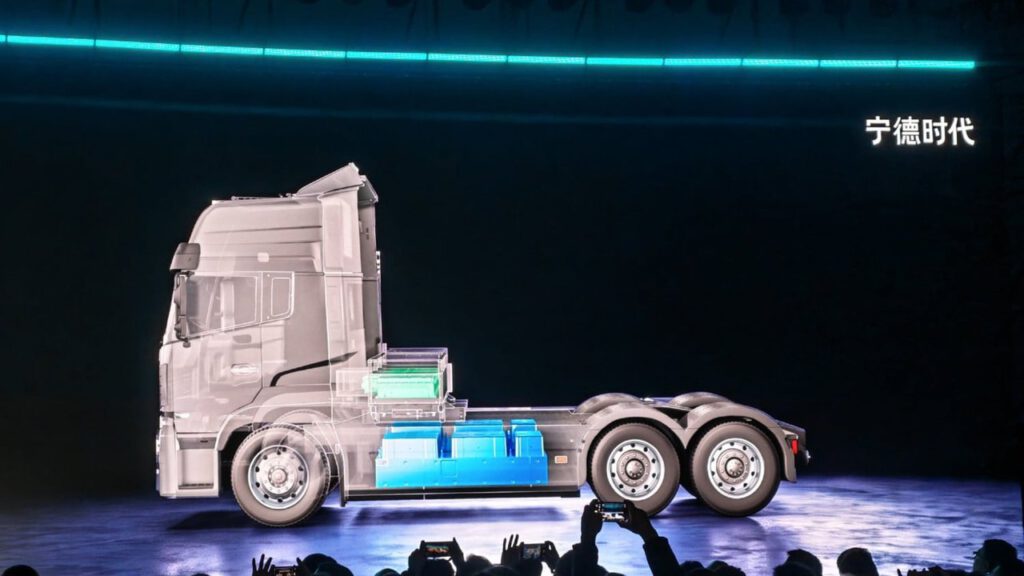

Contemporary Amperex Technology Co., Limited (CATL) unveiled its Dual-Electric Range Extender technology for heavy-duty trucks on October 20, 2026, alongside an expansion plan for its QiJi battery-swapping ecosystem. The company said more than 430,000 electric heavy trucks already use its batteries, representing over 70% of the global market. In China, electric heavy-truck penetration rose from 5.2% in 2022 to 50.28% in September 2026.
The system uses an “A+B” battery architecture. The primary, bottom-mounted pack is swappable and is available in 432 kWh and 513 kWh versions, while a fixed 77 kWh pack provides backup power. CATL said the backup pack allows the primary battery to be discharged to 5% state of charge before the truck switches to backup power. The company is offering the swappable battery under a leasing model intended to lower the vehicle’s upfront cost.
Combined with five-minute battery swapping, the design is intended to approach diesel-truck operating efficiency while reducing total cost of ownership. CATL estimated that the system could save users more than 460,000 yuan ($68,700) over three years compared with diesel trucks. It has standardized QiJi battery blocks in two formats: the 260# model with 432 kWh for trucks with a 3,800 mm wheelbase, and the 300# model with 513 kWh for a 4,200 mm wheelbase.
CATL unveils 513 kWh dual-battery truck system
Over 430,000 electric heavy trucks run on CATL batteries, representing over 70% of the world market as competition shifts to electric-versus-electric.
The 5 major trunk lines have over 5 million km of stable operation; 14 partner agreements carry an initial order volume of 13,000 units.
CATL said five major trunk routes are operating, with more than 5 million km of stable operation. It aims to have 900 swapping stations by the end of 2026, followed by 2,000 stations in 2027 covering the national highway network. Its eventual target is 10,000 stations. At the launch, CATL signed agreements with 14 partners, including SF Express, ZTO Express and YTO Express, linked to an initial order volume of 13,000 units.
Source: CarNewsChina.com