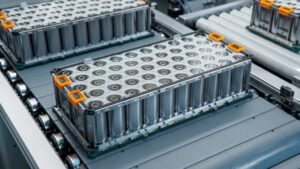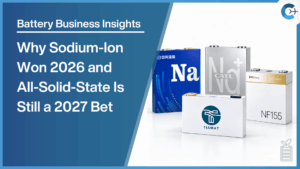


China’s sodium-ion battery sector is experiencing a clear structural shift in cathode chemistry, with polyanion-based materials increasingly favored over layered oxides, according to data from Shanghai Metals Market. In multiple reporting periods during late 2025 and early 2026, sodium iron phosphate-type (NFPP) cathodes represented more than 70% of domestic output, as layered oxide systems lost ground amid production adjustments and evolving demand.
Energy storage applications remain the primary driver for sodium-ion adoption in China, steering manufacturers toward materials that deliver long cycle life, stable costs and enhanced safety. Polyanion chemistries demonstrate robust structural integrity under repeated charge-discharge cycles, making them well suited for grid-scale installations. Layered oxide cathodes, by contrast, are more susceptible to structural degradation over time, constraining their appeal for stationary storage projects with stringent reliability requirements.
Safety validation efforts have intensified alongside commercial scaling. Laboratory tests have shown that some sodium-ion cells can withstand temperatures up to 300°C without entering thermal runaway. Development of non-flammable electrolyte formulations and system-level designs are also under way to bolster safety margins in large-format storage deployments.
While layered oxides continue in production, their growth is concentrated in niche segments such as higher-energy-density applications and early-stage mobility demonstrations. These materials typically involve higher-cost transition metals and more complex process controls, factors that limit their competitiveness in bulk storage markets.
As the industry moves from technical validation into industrial deployment, competition has shifted from peak performance metrics to cost-per-cycle and application compatibility. Commercial trials of sodium-ion systems in heavy-duty transport have reported gains in operational efficiency and driving range under real-world conditions. Cathode development is expected to remain diversified, with polyanion systems leading in energy storage, layered oxides targeting high-density use cases and Prussian blue analogues emerging for fast-charge scenarios.
Meanwhile, China’s electric-vehicle battery installations continue to be dominated by two leading suppliers. The market leader accounted for 25.7 GWh of recent installations, or roughly 42.5% of the total, while the runner-up contributed 10.1 GWh (16.6%). Three mid-tier manufacturers each hold between 4.5% and 5.8%, and a wider group of smaller firms make up the remaining, highly fragmented share. Together, the top two companies control nearly 60% of the market.
Source: CarNewsChina (https://carnewschina.com/2026/04/11/chinas-sodium-batteries-switch-to-cheaper-longer-lasting-cathodes-as-older-chemistry-gradually-declines/)