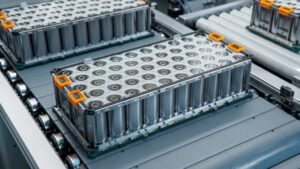


A recent industry initiative has developed a solvent-free dry coating process for lithium-ion battery cathodes, significantly reducing energy consumption compared to traditional wet coating methods. By eliminating energy-intensive drying, solvent recovery, and disposal steps, the approach offers both environmental and economic advantages.
Under the research project “Process and Material Development of Lithium-Ion Battery Cathodes for Large-Scale Dry Coating” (ProLiT), partners collaborated on an industrialization concept that integrates material formulation, process parameters, and specialized equipment. The effort focused on maintaining product quality, maximizing resource efficiency, and advancing sustainability throughout the production chain.
Experimental runs demonstrated that both lithium-iron phosphate (LFP) and nickel-manganese-cobalt (NMC) cathodes can be produced using PTFE-based and calender-gap-based dry coating techniques. Although multi-stage densification steps are required to achieve the desired electrode density, the results establish a solid foundation for scalable and cost-competitive industrial implementation.
Energy analyses indicate that the dry coating process achieves notable savings over conventional wet coating, positioning it as a key enabler for sustainable, lower-cost cell manufacturing. A white paper accompanying the project outlines a plant concept designed to deliver 1 GWh of annual cathode capacity, with insights that are directly transferable to gigafactory-scale operations targeting 10 GWh or more.
The ProLiT consortium brings together a broad cross-section of research and industry expertise, including advanced materials suppliers, academic institutions, equipment manufacturers, and cell producers. Key participants include IBU-tec advanced materials AG, Daikin Chemicals, TU Braunschweig, the IPAT Institute for Particle Technology, the University of Münster’s MEET Battery Research Center, Maschinenfabrik Gustav Eirich, Coperion K-Tron, Matthews Engineering, CustomCells, and an original equipment manufacturer with cell production capabilities.
Funded by the Federal Ministry for Economic Affairs and Climate Action (BMFTR), ProLiT aims to accelerate the adoption of dry coating in high-volume battery manufacturing.
Source: IBU-Volt News