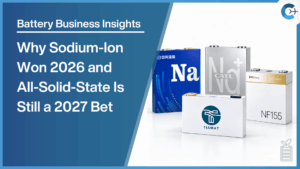


Recent developments in sodium-ion battery technology and new investment commitments indicate that this chemistry is gaining traction, despite persistent challenges. Sodium-ion batteries operate on similar electrochemical principles as lithium-ion cells but have advanced more slowly since their laboratory origins in the early 1980s. Commercial deployment began only in 2019 with stationary storage systems in China, followed by the first electric vehicle application in late 2023. By 2025, global sodium-ion production remained under 1 percent of lithium-ion output.
In the past two years, major battery manufacturers have accelerated efforts in this space. The world’s leading producer introduced a second-generation sodium-ion cell and plans to scale production across multiple sectors starting in 2026. Another top battery maker started building a dedicated plant in early 2024, targeting automotive, grid and industrial storage markets. Smaller firms have likewise unveiled enhanced sodium-ion designs for electric vehicles.
Key drivers include improved low-temperature performance and reduced reliance on lithium. Latest sodium-ion cells retain approximately 90 percent of their capacity at –40 °C and function at temperatures up to 70 °C. In markets with cold climates, this capability offers a distinct advantage over lithium iron phosphate batteries. Also, sodium-based chemistries sidestep lithium price volatility, which has seen material costs double over the past year even though they remain below peak levels.
However, sodium-ion batteries still lag in energy density, delivering up to 175 Wh/kg versus 205 Wh/kg for lithium iron phosphate and 255 Wh/kg for high-nickel cathodes. This gap yields a maximum driving range of about 350 km for an average SUV, compared with 400–600 km on current lithium-ion systems. Supply chain concentration is another constraint: more than 95 percent of planned capacity to 2030 is based in China, and recent setbacks in U.S. pilot projects underscore challenges outside that region.
Looking ahead, 2026 may prove pivotal as manufacturers seek to advance cell chemistry and diversify production locations. Greater energy density, sustained high lithium prices or further investment in international supply chains will be critical for sodium-ion batteries to move toward broader commercial competitiveness.
Source: IEA commentary