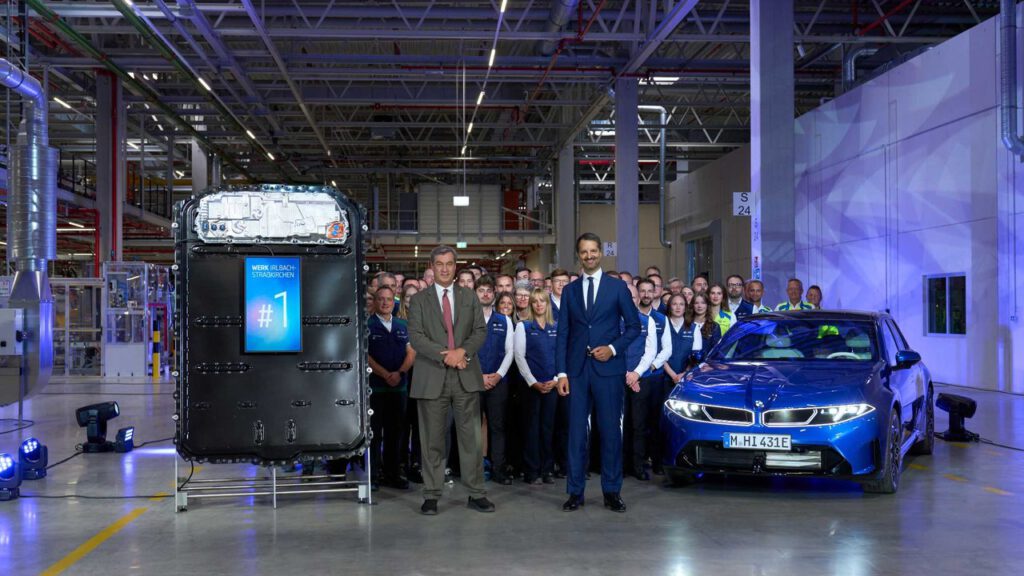

BMW Group officially opened Plant Irlbach-Straßkirchen in Bavaria on October 1, 2026, starting series production of sixth-generation high-voltage battery packs. The company invested around €1 billion in the site, which is supplying BMW Group Plant Munich with batteries for the new BMW i3. Production began on two shifts due to demand for Neue Klasse models.
Construction on the 60-hectare site began in April 2024, and the first pre-series battery was produced in March 2026. At full operation, the plant will employ around 1,600 people and produce several hundred high-voltage batteries per day across two production lines.
The 50,000-square-meter production area uses 500 robots, while BMW-developed artificial intelligence systems analyze manufacturing data and support equipment effectiveness. More than 3,500 data points are collected and monitored for each battery. Digital twins and virtual reality applications were also used for production planning and employee training.
The Gen6 design integrates cylindrical cells directly into the battery using a cell-to-pack approach. The assembled pack becomes part of the vehicle structure through BMW’s pack-to-open-body concept. Production includes cell inspection and clustering, laser cleaning and welding, foaming, housing sealing and riveting, installation of the Energy Master control unit, and a 100% end-of-line inspection.
The BMW i3 50 xDrive First Edition uses a 108.7 kWh battery and offers up to 906 kilometers of WLTP range. Its 800-volt system supports DC charging at up to 400 kW, allowing up to 423 kilometers of range to be added in 10 minutes under the stated test conditions. The vehicle also supports bidirectional charging.
The plant requires no fossil fuels for regular operations and no water for battery assembly. On-site photovoltaics provide part of its electricity, with additional energy supplied from renewable sources. BMW said the Gen6 cells use secondary cobalt, lithium and nickel, while carbon dioxide equivalent emissions per watt-hour are approximately 33% lower than for the previous Gen5 cell.
Source: BMW Group PressClub