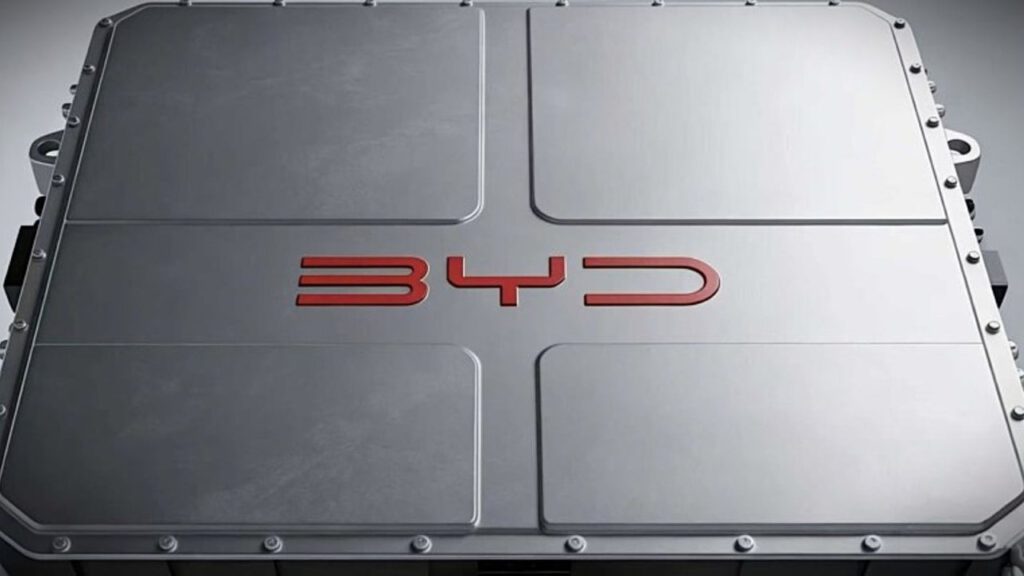

BYD has filed an invention patent application describing an immersion-cooled battery cabinet for stationary energy storage. Published by the China National Intellectual Property Administration on October 5, 2026, as CN 122868832 A, the application covers a two-chamber enclosure that separates submerged battery modules from electrical equipment. The application was filed in March 2025.
The proposed cabinet has an upper dry compartment containing electrical equipment and a lower liquid compartment holding cell modules submerged in a non-conductive dielectric fluid. The filing identifies hydrocarbon- and ester-based formulations as possible dielectric fluids.
Unlike indirect liquid-cooling systems, which transfer heat from battery modules through cold plates, the proposed arrangement places the modules directly in the cooling medium. This shortens the thermal path between the modules and fluid, but requires a liquid-tight separation between the submerged modules and electrical equipment not intended to operate in the fluid.
BYD’s application focuses on how electrical and signal connections cross that boundary. The design routes the connections through the upper portion of the liquid-filled compartment before they enter the dry compartment, rather than passing them through the floor or lower side walls of the wet chamber.
According to the filing, positioning the sealing interface higher in the cabinet reduces the hydrostatic pressure it experiences because liquid pressure increases with depth. The physical layout is intended to keep electrical equipment outside the liquid volume while maintaining connections to the submerged modules.
The application covers battery cabinets and energy storage equipment and does not identify a passenger vehicle use. It documents an enclosure architecture rather than a commercially available battery system. The application remains under substantive examination, and BYD has not announced production plans for the design.
Source: CarNewsChina.com