
The Fraunhofer Institute for Solar Energy Systems ISE reported on October 20, 2026, that its researchers operated 25-Ah pouch cells with silicon-rich anodes for more than 1,000 full cycles. The cells retained over 83 percent of their original capacity and achieved a gravimetric energy density of 280 Wh/kg in Fraunhofer ISE’s non-optimized PrecISE research cell format.
Fraunhofer ISE cells pass 1,000 full cycles
Silicon-rich pouch cells maintained high capacity retention, advancing a chemistry whose industrial adoption has been constrained by limited cycle life.
The cells clear the target of more than 1,000 cycles with capacity retention of at least 80 percent.
Developed under the StrOboBatt project, the multilayer full cells contained 40 layers and used commercially available electrode foils. The cells combined a silicon-carbon/graphite anode with a nickel-rich nickel-manganese-cobalt oxide cathode. The silicon-carbon composite represented 51 percent of the anode active material. The anodes delivered a specific capacity above 1,000 mAh/g and an areal specific capacity above 5 mAh/cm².
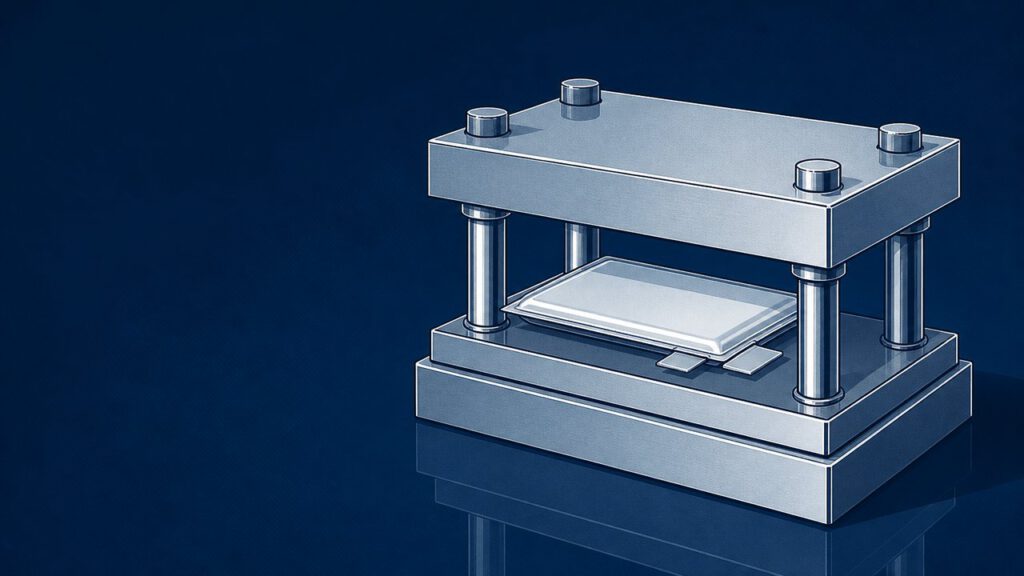
Fraunhofer ISE manufactured the pouch cells on a semi-automatic production line in the cleanroom of its Center for Electrical Energy Storage. The researchers also examined how mechanical pressure affected cell performance during charging and discharging at 1C. Cells were tested at axial contact pressures of 300 kPa and 1,000 kPa, with regular check-up cycles conducted at lower current rates.
At 1,000 kPa, the cells retained more than 83 percent of their initial capacity after over 1,000 full cycles. At 300 kPa, the researchers observed a substantially greater decline in usable capacity over time, particularly during 1C operation. Fraunhofer ISE said external axial pressure can improve interfacial resistance and reduce the risk of electrode materials separating from each other or from the substrate.
The tests also showed a growing difference between residual capacity measured at a low discharge rate and the capacity available during regular 1C operation. According to the institute, this indicates that silicon-rich cells should be assessed under practical operating conditions rather than through capacity-retention measurements alone. Fraunhofer ISE expects an industrially optimized pouch cell using the approach to reach approximately 330 Wh/kg.
Source: ise.fraunhofer.de