

On July 13, 2026, a topping-out ceremony marked the start of the second construction phase of the Fraunhofer Research Institution for Battery Cell Production (FFB) in Münster. Attended by North Rhine-Westphalia Minister President Hendrik Wüst, State Minister of Economic Affairs Mona Neubaur, and Federal Minister for Research Dorothee Bär, the event celebrated the expansion of Europe’s largest open battery cell research facility.
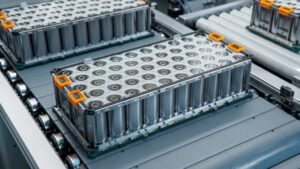
Since early 2024, the first building—“FFB PreFab”—has hosted more than 140 scientists working on industry-oriented production of lithium-ion cells. PreFab replicates the entire manufacturing sequence, from incoming materials inspection to finished cells, and accommodates laboratory samples, prototypes, and pilot-line production. The new “FFB Fab” will add over 20,000 square meters of gigafactory-scale equipment, bringing the total site area to roughly 56,000 square meters and covering the full innovation pathway from lab validation to near-series manufacturing.
The federal and state governments are jointly investing about one billion euros in the project. The federal government is contributing up to 750 million euros, while North Rhine-Westphalia is providing approximately 320 million euros as project owner. The Fraunhofer Society leads the consortium, collaborating with the MEET Battery Research Center at the University of Münster, the PEM Chair at RWTH Aachen University, and the Helmholtz Institute Münster, a branch of the Jülich Research Center. NRW.URBAN is overseeing construction on behalf of the state.
Speakers emphasized the facility’s role in closing the gap between research and industrial scale-up, boosting Europe’s technological sovereignty, and reinforcing Germany’s position as an industrial innovation hub. The open-access infrastructure invites companies of all sizes to test and refine cell chemistries, production processes, and equipment under fully digitized conditions.
Once operational, FFB Fab will serve as a nucleus for competitive European battery cell production, supporting climate-friendly mobility and energy storage solutions. The combined capabilities of PreFab and Fab are expected to accelerate technology transfer, foster partnerships across the value chain, and secure high-skill jobs in the region.
Source: Fraunhofer FFB press release