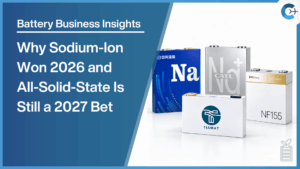


Li Shujun, general manager of Hina Battery, said in a recent interview that the cost gap between sodium-ion and lithium-ion batteries is set to close within the next two years. He noted that sodium-ion battery costs have been declining rapidly, while lithium-ion prices have edged upward, creating an imminent overlap in their respective price ranges.
Currently, lithium-ion batteries are priced between 0.3 yuan and 0.5 yuan per watt-hour, depending on cell chemistry and application. Sodium-ion batteries, by comparison, range from 0.5 yuan to 0.7 yuan per watt-hour. High costs have so far constrained sodium-ion adoption at scale, but Li expects the two chemistries to reach price parity by 2027 or 2028. He predicts the first convergence point will emerge next year, with a broader overlap appearing the year after. According to Li, this milestone will signal that the market has integrated sodium-ion technology into mainstream battery offerings, bolstering confidence among automakers and energy storage developers.
Speaking at Hina’s 2026 Global Sodium Battery Industry Ecology Conference, Li forecast that by 2028 the performance battery segment will drive sodium-ion production to an industrial scale measured in hundreds of gigawatt-hours. He projected that cell costs would fall to around 0.3 yuan per watt-hour, while energy density for power-type sodium-ion batteries would climb above 180 watt-hours per kilogram thanks to ongoing materials and manufacturing advances.
Several major battery manufacturers and automakers are already advancing sodium-ion commercialization. In April 2025, CATL introduced its Naxtra sodium-ion battery, which offers an energy density of 175 Wh/kg and enables a 400 km electric range in a Changan Automobile model slated for mid-2026 launch. BYD has developed a sodium-ion cell with a 10,000-cycle lifespan, and BAIC Group’s Aurora sodium-ion battery delivers up to 450 km of range. Meanwhile, LG Energy Solution plans to complete a pilot production line this year and begin sample output shortly thereafter. These initiatives underscore growing industry momentum behind sodium-ion technology as a cost-effective alternative to traditional lithium-ion batteries.
Source: ChinaEVPost