
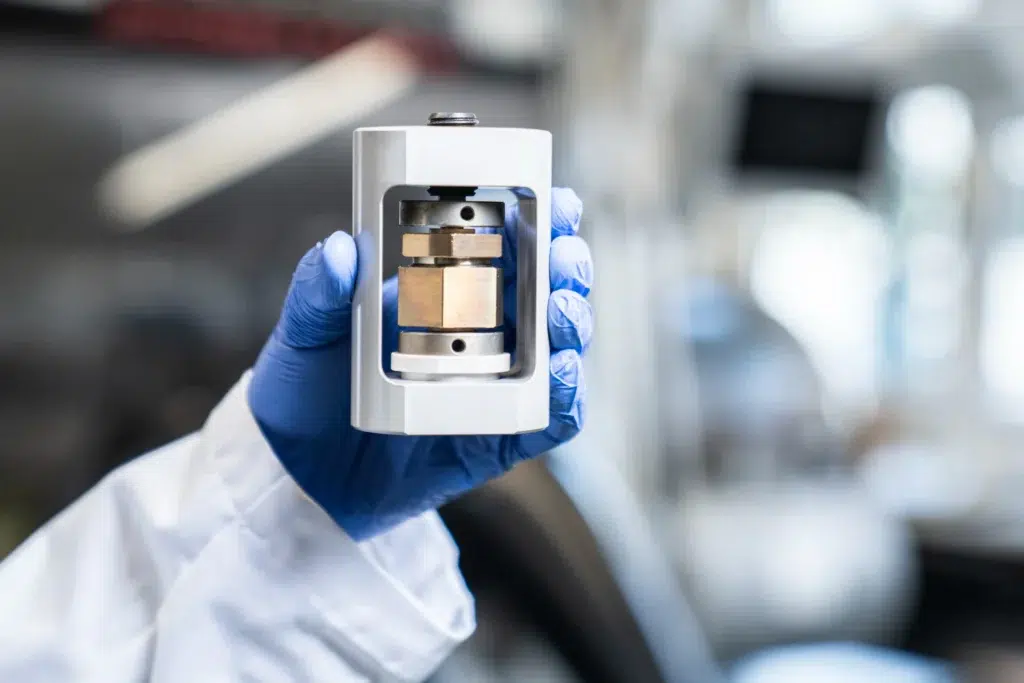

Researchers at the Paul Scherrer Institute have developed a new, cost-effective manufacturing process for lithium metal all-solid-state batteries that addresses two major challenges: lithium dendrite formation and interfacial instability. All-solid-state batteries replace flammable liquid electrolytes with a solid one, offering improved safety and higher potential energy density for applications in electric mobility, portable electronics, and stationary storage.
The team, led by Mario El Kazzi of PSI’s Battery Materials and Diagnostics group, focused on the argyrodite-type Li₆PS₅Cl (LPSCl) solid electrolyte, known for its high lithium-ion conductivity. To achieve a dense, uniform microstructure resistant to dendrite penetration, the researchers combined moderate heat (around 80 °C) and pressure in a gentle sintering step. This mild sintering closed voids and enhanced particle bonding without compromising the electrolyte’s chemical stability.
Next, they applied a 65-nanometer lithium fluoride (LiF) coating to the anode surface via vacuum evaporation. This ultrathin passivation layer serves two functions: it prevents electrochemical decomposition of the solid electrolyte at the lithium interface and acts as a physical barrier against dendrite growth.
In laboratory tests using button cells, the modified all-solid-state design demonstrated significant cycle stability at high voltage. After 1,500 charge–discharge cycles, the cells retained about 75 percent of their initial capacity, one of the highest retention rates reported to date. Lead author Jinsong Zhang noted that these results suggest solid-state batteries could soon outperform conventional lithium-ion cells in energy density and longevity.
Beyond performance gains, the low-temperature, low-pressure process offers energy and cost savings, making it more compatible with industrial production. “Our approach is a practical solution for argyrodite-based all-solid-state batteries,” said El Kazzi. With further optimization, the method could be ready for scale-up and commercial deployment.
Source: Paul Scherrer Institute