
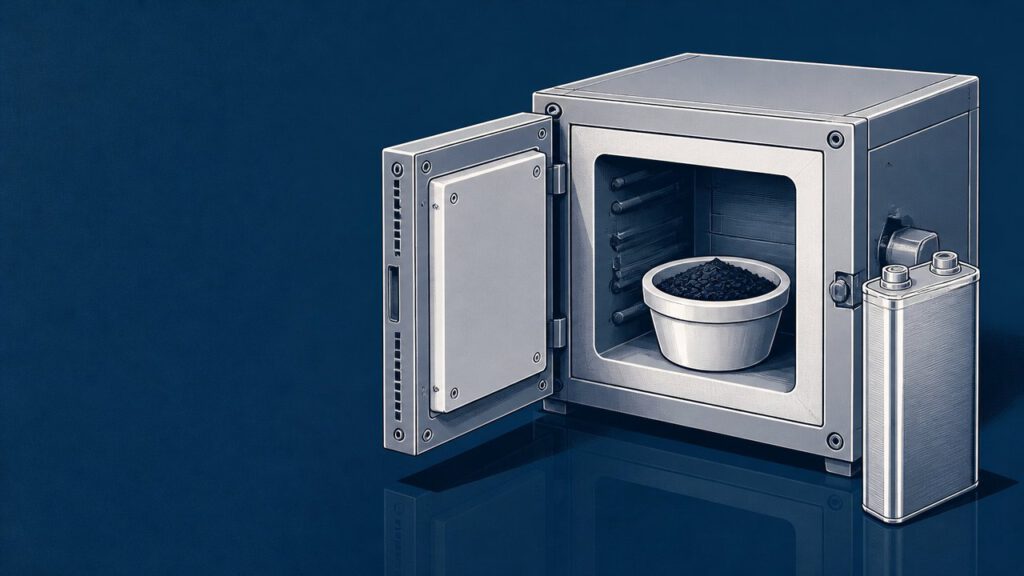

On November 26, 2026, researchers at Rice University announced a synthetic graphite production method designed to improve lithium-ion battery charging performance. The process adds a small amount of a nickel compound to petroleum coke, a low-cost carbon residue from oil refining, and applies a single, powerful electrical pulse. The study was published in Advanced Materials.
Rice Graphite Anode Tolerates Four-Minute Charging Rate
A nickel-assisted electrical pulse created low-defect graphite in a fraction of a second, enabling much faster lithium-ion battery charging.
Graphite is two-dimensional, with layers one atom thick; nickel helps order and slightly separate them for lithium entry.
The pulse briefly heats the mixture to about 2,500 C and converts it into graphite in two-tenths of a second. According to the researchers, the nickel helps carbon atoms rapidly organize around small nickel particles, producing highly ordered, low-defect graphite. The material’s layered structure was slightly expanded, providing greater access for lithium ions as they enter the anode during charging.
In lithium-ion battery tests, the nickel-formed graphite significantly outperformed conventional graphite during charging and tolerated a rate equivalent to a four-minute charging time. It retained 80% of its capacity after 1,000 charge-discharge cycles, with each cycle involving a full discharge followed by recharging. The researchers said the results show potential for fast-charging anodes.
The benefit persisted after more than 99% of the residual nickel was removed, suggesting that nickel’s main contribution was the graphite structure formed during processing rather than its continued presence in the material. The team also found that an intermediate temperature range was important: Excessively high temperatures caused much of the nickel to be lost, while lower temperatures produced less ordered graphite.
Conventional graphite production typically requires prolonged heating at extremely high temperatures. An analysis by the Rice team suggests the pulse process could reduce energy consumption and greenhouse gas emissions by more than 80% compared with conventional graphite production. Corresponding author James Tour said the method could also reduce production costs and environmental impacts while supporting faster charging for future electric vehicle batteries.
Source: news.rice.edu