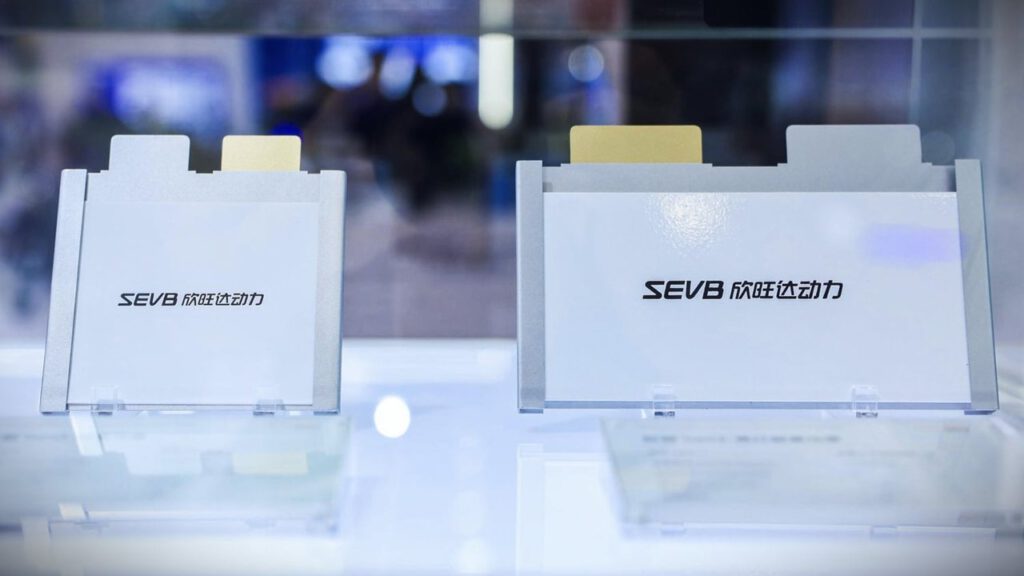

Sunwoda Electric Vehicle Battery Co., Ltd. (SEVB), the automotive battery subsidiary of Sunwoda Electronic Co., Ltd., said its polymer-composite solid-state battery has completed design and process verification and remains under customer evaluation. The company disclosed the update on October 30 through the Shenzhen Stock Exchange’s investor interaction platform. It did not identify the automakers evaluating the cells or provide sample volumes.
SEVB previously reported customer testing in May 2026, indicating that the latest disclosure is an update to the existing program. Contemporary Amperex Technology Co., Limited (CATL), which is developing sulfide-based solid-state cells, reaffirmed its target for small-batch production in 2027. CATL previously reported a 20 Ah prototype in 2024.
Sunwoda’s 20 Ah Xin Bixiao cell has a reported energy density of 400 Wh/kg and a cycle life exceeding 1,200 cycles under external pressure below 1 MPa. Its design includes a 12-micron polymer-composite membrane and a nanoscale high-entropy silicon anode. The company also reported that the cell passed a 200°C hot-box test.
Sunwoda tests 400 Wh/kg solid-state cells with automakers
Sunwoda’s October 30 update extends customer testing reported in May 2026; CATL’s October 27 response retained 2027 after its 20 Ah prototype in 2024.
For illustration: 55 kWh to 80 kWh raises 550 km CLTC (approximately 450 km WLTP) to 800 km CLTC (approximately 660 km WLTP).
Sunwoda said its polymer-composite design can accommodate electrode movement while maintaining contact between cell components. The pressure requirement below 1 MPa could reduce battery pack structural requirements, although the cell-level results do not demonstrate that additional support can be eliminated or confirm equivalent performance in a complete vehicle battery.
SEVB has connected a solid-state battery pilot line with an annual design capacity of 0.2 GWh. Its development roadmap includes a second-generation sulfide battery targeted for 2027 and a future cell exceeding 500 Wh/kg targeted for 2030. These are development targets rather than confirmed commercial production dates.
Sulfide electrolytes require moisture-controlled production because contact with water can release hydrogen sulfide. Shanghai Metals Market assessed lithium phosphorus sulfur chloride at approximately 3,500 to 4,500 yuan per kilogram, compared with around 30 to 50 yuan per kilogram for conventional liquid electrolytes, although the materials are not direct substitutes.
Sunwoda is also involved in an aviation battery research center targeting cell energy density of at least 450 Wh/kg and continuous discharge power density of at least 1,000 W/kg for eVTOL applications. The disclosed targets do not establish commercial orders or production volumes.
Source: CarNewsChina.com