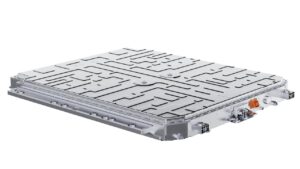

Volkswagen may further integrate its Unified Cell battery strategy by involving the Göd plant in Hungary for partial cell manufacturing. According to reports from The Elec, Samsung SDI has secured a significant contract to produce Volkswagen’s standard battery cells, with some volume potentially assigned to the facility near Budapest. If confirmed, this would position Göd as a strategic pillar in Volkswagen Group’s European battery network rather than a routine supplier site.
The Unified Cell concept, unveiled by Volkswagen’s former CEO in March 2021, centers on a uniform prismatic cell measuring 256 x 24.8 x 106 millimeters. By standardizing cell dimensions across models, Volkswagen aims to streamline procurement, production, and logistics. The cell architecture also accommodates multiple chemistries—such as lithium iron phosphate (LFP) and nickel-manganese-cobalt (NMC)—and is designed for future adaptation to solid-state formats, ensuring flexibility as battery technology evolves.
To date, Unified Cell production has been carried out at Volkswagen PowerCo’s Salzgitter plant in Germany and at Gotion’s factory in Hefei, China. Under Volkswagen’s “Make AND Buy” approach, the automaker balances in-house capabilities with partnerships. PowerCo declined to confirm or deny the Samsung SDI collaboration, citing its policy of not commenting on supplier-related news.
Industry estimates suggest Göd could convert two production lines to deliver around 20–30 gigawatt-hours annually. Given that an average electric vehicle battery is roughly 60–70 kilowatt-hours, this capacity translates to cells for approximately 300,000–460,000 vehicles per year—comparable to the annual output of a mid-sized European automaker.
Besides boosting capacity, localizing production in Hungary aligns with the European Union’s proposed Industrial Accelerator Act, which aims to strengthen domestic value creation and “Made in EU” criteria. Should Samsung SDI’s Göd plant become an established hub for Unified Cell production, it would reinforce Volkswagen’s European battery strategy and could attract long-term investment and job growth in Hungary.
Source: Hungary Today