
WEG has announced the development of a new manufacturing facility dedicated to battery energy storage systems (BESS) in Itajaí, Santa Catarina, Brazil. The advanced plant will increase WEG’s annual BESS production capacity to 2 gigawatt-hours, equivalent to approximately 400 units of 5 MWh each. Construction is scheduled to begin shortly, with completion expected in the second half of 2027.
To support the project, WEG secured BRL 280 million in financing through the BNDES More Innovation program, under a public call focused on strategic minerals for energy transition and decarbonization in partnership with Finep. The facility will feature a high level of automation, including automatic and semi-automatic assembly lines, as well as autonomous mobile robots for internal logistics.
In addition to manufacturing, the complex will house a laboratory for product testing, development and qualification to ensure quality control and accelerate new solution development. An on-site electrical substation will enable simulation of real operating conditions for system validation and reliability testing.
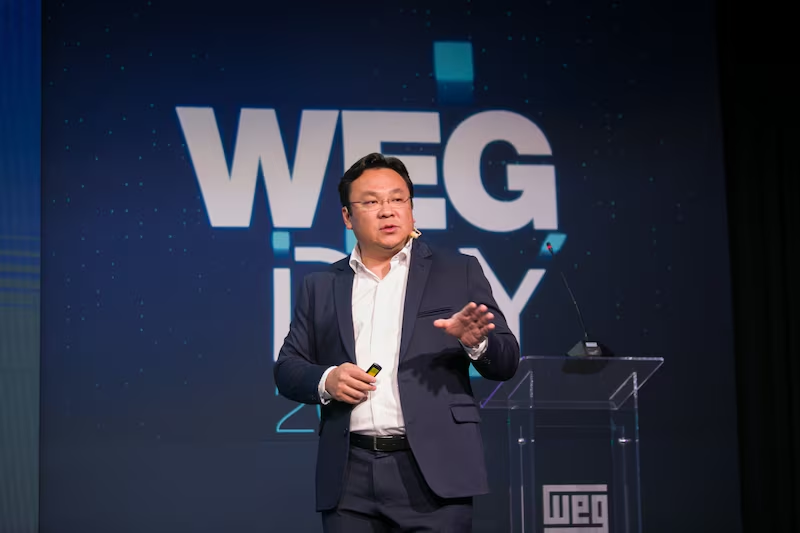
“With this step, WEG expands its portfolio of high value-added solutions, developed and manufactured in Brazil, and contributes to strengthening energy security and the resilience of our grid. This investment is aligned with the strategic objective of positioning WEG and Brazil more competitively in the global energy transition landscape, mitigating risks and strengthening the country’s presence in this growing segment,” explains Alberto Kuba, President of WEG.
The new plant is expected to generate around 90 direct jobs, contributing to local economic development. Battery energy storage systems play a critical role in stabilizing power grids by storing excess energy during low-demand periods and releasing it when needed, supporting the integration of renewable sources such as solar and wind and helping to reduce the risk of outages.
Source: WEG