
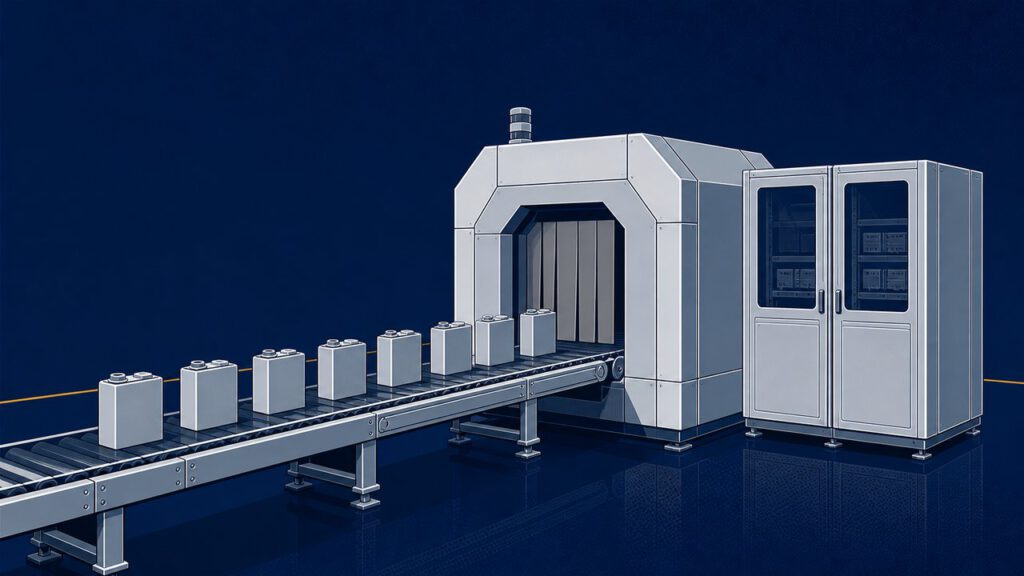

Xnovo Technology ApS announced on September 1, 2026, that it has deployed an automated inspection system for 3D computed tomography (3D-CT) data at the BMW Group’s Cell Manufacturing Competence Centre in Parsdorf, Germany. The system is designed to provide high-throughput quality assurance for battery cells on the production floor. Xnovo said the installation brings 3D-CT inspection into a 24/7 industrial manufacturing environment.
3D-CT provides nondestructive views of internal component structures, but production deployment requires scans to be completed within seconds rather than the hours that laboratory scans can take. According to Xnovo, faster scans create more noise, CT artifacts and lower contrast, making conventional inspection workflows less reliable.
The inspection workflow begins with automated image preprocessing, including beam-hardening correction, volume alignment and battery component segmentation. It then applies deep learning-based analysis using Xnovo’s proprietary anomaly detection, generates automated reports and connects to factory data systems through OPC UA and Q-DAS interfaces. The company said the distributed architecture can scale with production throughput while giving operators real-time visibility into production quality.
Xnovo developed the system in close alignment with BMW Group engineering teams and integrated the automaker’s own analysis methods into the inspection pipeline. The companies said this aligns the tool with BMW Group’s internal quality standards and production workflows. Stefan Kerscher, head of Battery Cell Technology Development at BMW Group, said the project combined the automaker’s battery production and quality assurance expertise with Xnovo’s image processing and artificial intelligence capabilities.
The technology was also presented in a joint talk by Simon Schmid of the BMW Group CMCC and Sven Gondrom-Linke of Xnovo Technology at the European Conference on Non-Destructive Testing 2026 in Verona, Italy.
Source: xnovotech.com