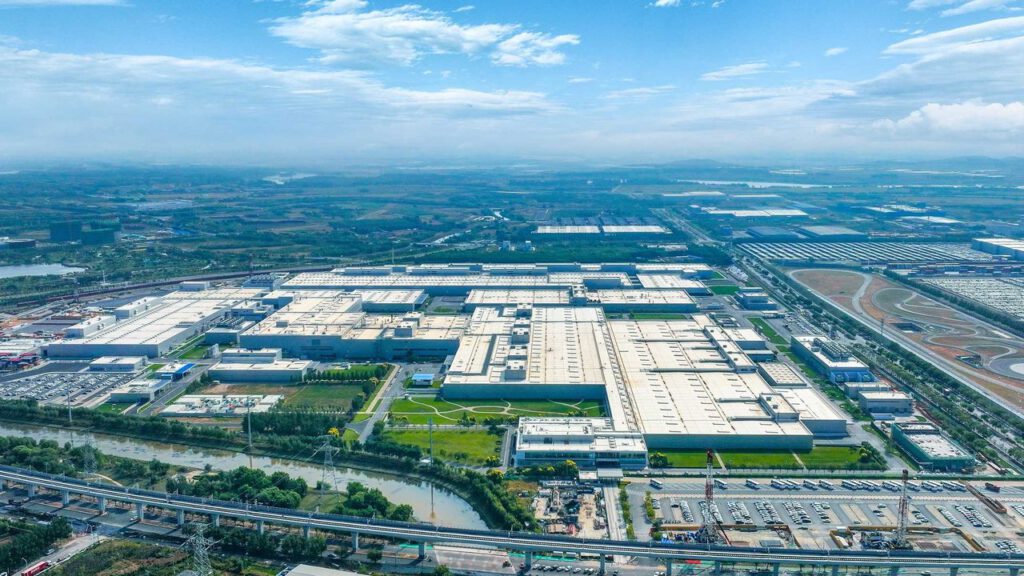

BMW Group announced on October 1, 2026, that it has begun series production of Gen6 high-voltage batteries in Shenyang. The Chinese site is the third location in the company’s global Gen6 battery production network, following Debrecen, Hungary, and Irlbach-Straßkirchen, Germany. The batteries assembled in Shenyang will supply future Neue Klasse electric models built in China.
BMW starts Gen6 production at third global location
Shenyang follows Debrecen and Irlbach-Straßkirchen, localizing batteries for future China-built Neue Klasse models.
Scale context: BMW sold 2.46 million passenger vehicles and more than 202,500 motorcycles in 2025; it had 154,540 employees as of 31 December 2025.
Gen6 technology uses newly developed cylindrical cells that provide more than 20 percent higher energy density than the previous cell generation, according to BMW. Charging speed and range increase by up to 30 percent. A cell-to-pack design integrates the cells directly into the battery housing, removing the conventional module level and using the available installation space more efficiently.
The battery also incorporates BMW’s Energy Master, a central control unit mounted directly on the high-voltage battery. It consolidates key power-supply and battery-management functions.
BMW is locating Gen6 battery assembly close to its vehicle plants to shorten transportation routes and support supply stability. Additional assembly sites in Woodruff, United States, and San Luis Potosí, Mexico, are scheduled to begin series production in the coming months. The company said uniform production, quality and safety standards apply across the network.
In Shenyang, battery cells are inspected and joined with cooling units to form cell clusters. The clusters undergo laser cleaning before being precision-welded to the cell contact system. A foaming process then bonds the components into a mechanical unit. The housing is closed, sealed and riveted before the Energy Master is installed and the completed battery undergoes end-of-line testing.
Production data is captured and analyzed throughout manufacturing. BMW uses digital twins, data analytics, AI-supported inspection and inline monitoring to identify deviations and maintain traceability. Laser-welded joints are monitored in real time, while each finished battery is tested for quality, safety and functionality.
Source: press.bmwgroup.com