
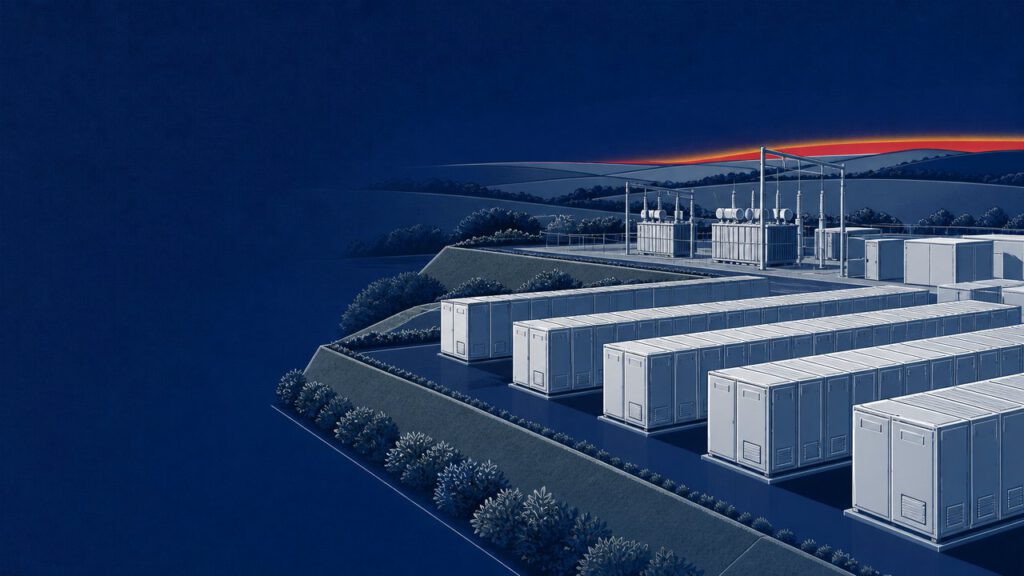

The regional authority in Saxony, Germany, announced on November 27, 2026, that it approved construction of a 700 MW/2,800 MWh battery energy storage project in Wegefarth, a locality in the municipality of Oberschöna in the Mittelsachsen district. Danish company CI V Gigastar ProjectCo GmbH secured planning approval for the development.
Saxony approves 700 MW/2,800 MWh battery project
Planning approval clears storage construction in two phases, with the completed battery expected to support Saxony’s grid stability.
Both rows are neutral: approval sets the build sequence, with the two sections operating as independent units.
The facility will be built in two phases on an 11.06-hectare site. The first phase will provide 500 MW of power capacity, while the second phase will add 200 MW. According to the authority, the two sections will operate as independent units.
The project will connect to the transmission grid through a new substation and a 380 kV underground cable linked to the existing Freiberg Nord substation. Earth berms will define the facility’s boundaries and provide visual screening, with native shrub hedges planted along their outer sides.
Demolition and land de-sealing work is planned in the nearby city of Brand-Erbisdorf to compensate for the project’s effects on nature and the landscape. The planning approval process considered around 100 objections, including 66 submitted by private individuals and two from nature conservation organizations.
The planning decision is due to be published on the authority’s website from November 30 for two weeks. If no legal action is brought during that period, CI V Gigastar ProjectCo can begin implementing the project. The authority said processing a battery storage development of this scale was a new undertaking and presented particular challenges for the officials involved.
Once completed, the battery is expected to support grid stability. Béla Bélafi, president of the regional authority, said its stored energy could theoretically meet the average daily electricity demand of approximately 250,000 to 300,000 households, comparable to the daily demand of a large city such as Chemnitz or Leipzig.
Source: Energy Storage