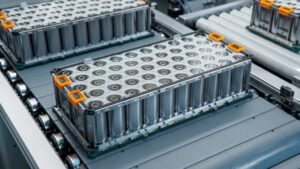


Technology company Donut Lab said it has received new independent test results for its battery technology. According to a report from the research organization VTT, the Donut Battery achieved an energy density of 409 watt-hours per kilogram and 805 watt-hours per liter.
Ville Piippo, CTO at Donut Lab, said the test was straightforward because energy density depends on how much energy a battery cell stores and how much it weighs or occupies. He said the cell used in the test had the same chemistry as in VTT’s earlier work, but had been optimized for energy as part of the company’s broader development effort.
VTT began the evaluation by weighing and measuring the cell. The battery was then fully charged and discharged at 25 degrees Celsius across the cell’s full voltage range to determine the total energy that could be extracted. Gravimetric energy density was calculated by dividing energy by mass, while volumetric energy density was calculated by dividing energy by volume.
“Today’s test result and the other features that were demonstrated this spring not only show that the Donut Battery is an exceptional innovation. They also reflect the limitless possibilities of our technology, which we can increase with relatively light optimisations. After the launch, we have focused on manufacturing the next generation of cells, and we plan to scale their production to an industrial level,” says Marko Lehtimäki, CEO of Donut Lab.
The company said its customer base spans vehicles, drones, and battery energy storage systems. Donut Lab said it develops tailored battery variations rather than a single standardized product, with the goal of meeting the technical requirements of different industries.
Donut Lab also said it is working with Intertek on tests of its next-generation battery cells. Intertek examined the internal architecture and confirmed a bipolar structure, in which multiple electrochemical layers are connected in series within a single cell. According to Donut Lab, the structure is consistent with a solid electrolyte, since a liquid electrolyte would not support this design.
Intertek also conducted a nail penetration test on the next-generation cell. In that test, a steel nail was driven through a fully charged battery cell and left in place for one hour to simulate a permanent internal short circuit. Donut Lab said the cell remained stable throughout the test.
VTT’s and Intertek’s reports are available at Idonutbelieve.com.
Source: Donut Lab