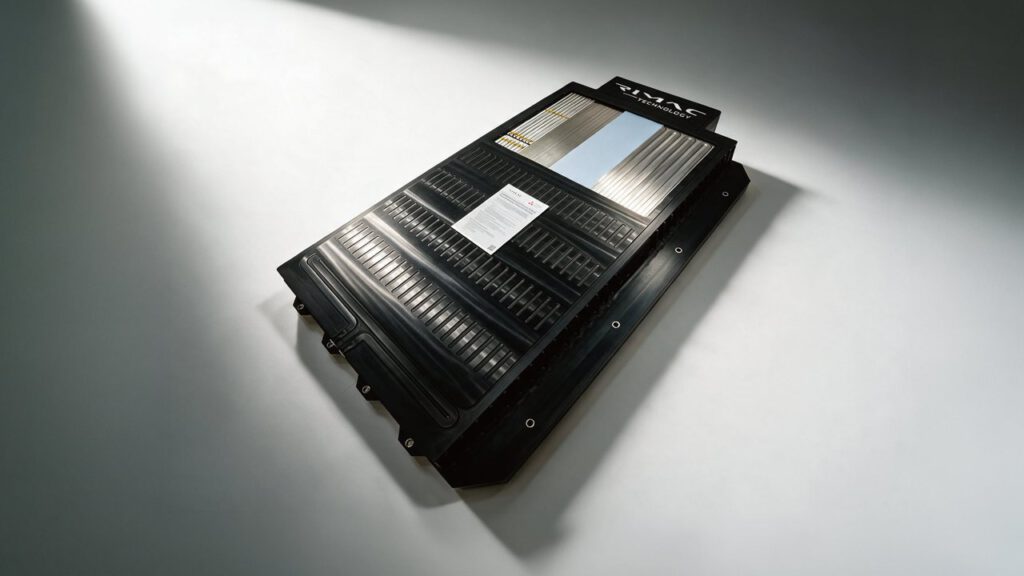

ProLogium Technology Co., Ltd. and Rimac Technology announced on October 12, 2026, that they have completed a concept mockup for a next-generation electric vehicle battery pack. The companies plan to display the mockup at the 2026 Paris Motor Show before moving to functional hardware development.
The companies signed a Memorandum of Understanding in September 2025 to develop a battery platform combining ProLogium’s next-generation cell technology with Rimac Technology’s battery system engineering. The project focuses on a pouch cell-to-pack architecture intended for battery electric vehicle applications.
The next phase involves developing a functional battery segment to test thermal management and cell-integration concepts. Rimac Technology is evaluating multiple approaches covering thermal management, swelling management, cell integration and system-level design. The companies will use test results and design feedback from the segment to assess whether the architecture can meet automotive battery system requirements before progressing to a full-scale pack.
Some integration approaches are intended to maximize energy density and reduce space and weight, while others prioritize performance. The development work begins with vehicle-level requirements and seeks to reduce design complexity, combine functions and lower battery weight while considering cost, charging times and power output.
Under Rimac Technology’s current roadmap, the functional battery segment is planned for display at CES 2027. A full-scale functional battery pack is targeted as a development milestone for the second half of 2027, followed by in-vehicle and public-road testing in the second half of 2028.
ProLogium and Rimac Target 2027 Functional Battery Pack
A completed concept mockup advances a September 2025 collaboration toward functional hardware, with segment validation preceding pack-scale and vehicle testing.
The sequence matters: each neutral row marks a validation step, not a performance gain or decline.
The staged program will expand validation from the functional segment to a complete battery pack and then to installation and testing in a vehicle. The companies said the process is intended to connect next-generation cell development with automotive product requirements through successive hardware and testing phases.
Source: ProLogium Technology Co., Ltd