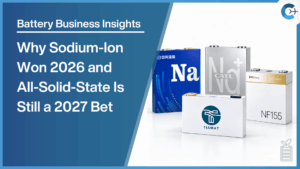

Contemporary Amperex Technology Co., Limited (CATL) announced at the 2026 Equipment Powerhouse Forum on May 30 that it will introduce a series of mass-produced sodium-ion battery products this year. Wu Kai, CATL’s chief scientist and academician of the Chinese Academy of Engineering, confirmed that the company has overcome key manufacturing bottlenecks. The new sodium-ion batteries are designed to take advantage of more abundant and lower-cost raw materials compared with conventional lithium-ion chemistries.
According to CATL’s published roadmap, the company plans to deploy these sodium-ion systems in passenger vehicles, commercial fleets, battery-swapping networks and stationary energy-storage applications. At the same time, CATL is advancing its long-term research into high-density lithium-air batteries. The sodium-ion push follows a landmark 60 GWh supply contract—the largest single order for sodium-ion cells to date. By relying on widely available precursors rather than constrained lithium sources, the technology aims to streamline the supply chain and reduce material costs.
Early sodium-ion offerings will focus on entry-level electric vehicles and energy-storage installations. CATL is also developing advanced cell architectures intended to achieve longer driving ranges; future versions of these batteries target a single-charge range of up to 600 kilometers, positioning sodium-ion as a competitor to lower-tier lithium-iron-phosphate configurations.
In parallel with its sodium-ion program, CATL is pursuing lithium-air technology. This approach uses metallic lithium as the anode and draws oxygen from the atmosphere at the cathode, eliminating heavy host compounds in the cell. During discharge, the reaction forms lithium peroxide, unlocking a substantially higher theoretical energy density than current solid-state or liquid-electrolyte batteries. CATL views lithium-air as a potential long-term successor to conventional lithium-ion systems.
The sodium-ion initiative comes amid CATL’s sustained leadership in mainstream battery markets. Data from a domestic EV tracker show that CATL installed 29.06 GWh of batteries in April 2026, equivalent to a 46.6 percent nationwide market share. That volume included roughly 19.53 GWh of lithium-iron-phosphate modules and 9.53 GWh of nickel-manganese-cobalt cells. Integrating sodium-ion production creates a parallel manufacturing line alongside CATL’s established lithium-based platforms.
Source: Car News China