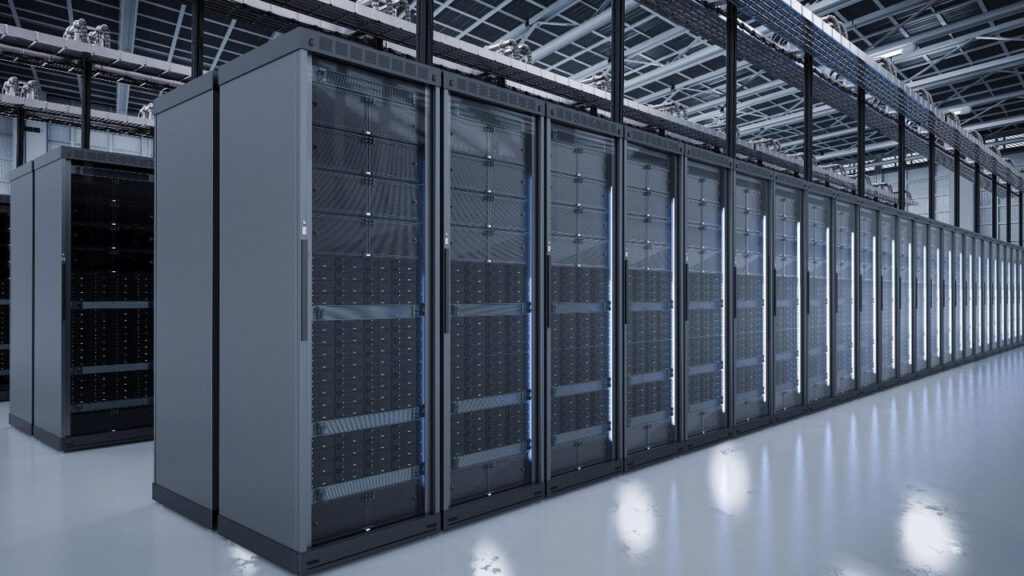

A CIC energiGUNE white paper estimates that global data center electricity consumption reached approximately 485 TWh in 2025 and could rise to around 950 TWh by 2030, equivalent to nearly 3% of worldwide electricity demand. The report projects that approximately 20–25 GW of battery storage capacity could be installed in data centers worldwide by 2030.
Data Centers Could Deploy 20–25 GW of Storage by 2030
Worldwide data centers could install 20–25 GW of battery storage by 2030 as AI workloads raise power density and reshape electrical infrastructure.
The key shift is both scale and role: storage is moving beyond backup toward peak management, renewable integration and grid interaction.
Artificial intelligence workloads are driving higher power density and more concentrated electricity use. According to the report, AI server power density increased approximately elevenfold between 2020 and 2025 and could rise further. This shift requires transformers, switchgear, cooling systems, power electronics, uninterruptible power supply units and batteries to handle larger and more rapidly changing power flows.
Battery selection criteria vary by application. Rack- or row-level backup units require high power, compact dimensions and rapid response, along with thermal management, fault detection and safety systems. Centralized UPS batteries may remain at a high state of charge for long periods with few deep discharges, making calendar life, predictable aging and state-of-health assessment particularly important.
Facility-level battery energy storage systems can support resilience while also reducing demand peaks, integrating renewable generation and assisting on-site energy management. Additional use beyond backup will depend on operational and regulatory conditions because operators must retain sufficient charge, available power, service life and redundancy for mission-critical functions.
The report expects multiple storage technologies to coexist, including lead-acid, LFP, NMC, sodium-ion, high-power lithium, zinc-based systems, supercapacitors and flow batteries. Their suitability will depend on power, discharge duration, safety, service life, available space and cost. Hybrid systems could use very-high-power technologies for rapid fluctuations and higher-capacity batteries for longer-duration storage.
CIC energiGUNE said opportunities extend beyond cell manufacturing to battery management systems, thermal management, power electronics, fire protection, predictive diagnostics and energy optimization. The report argues that data center storage should be evaluated through total cost of ownership, including maintenance, replacement, efficiency, cooling, space, degradation and the potential cost of unavailability.
Source: cicenergigune.com