
Researchers at the Development Center X-ray Technology of Fraunhofer IIS and Hochschule München have developed the AIR system to assess the mechanical integrity of used and accident-damaged high-voltage batteries. The system inspects closed battery packs without opening them or dismantling components, supporting evaluations for reuse, transportation and further testing.
AIR uses X-ray scanning and automated analysis of 2D projections to detect cylindrical, prismatic and pouch cells. Its software identifies geometric irregularities that may indicate cell displacement, deformation or swelling. Depending on the inspection setup, either a battery pack or an entire vehicle moves through the X-ray beam. In the test environment, evaluating one battery pack took approximately five minutes, although total inspection time varies with pack size, setup and the number of projections.
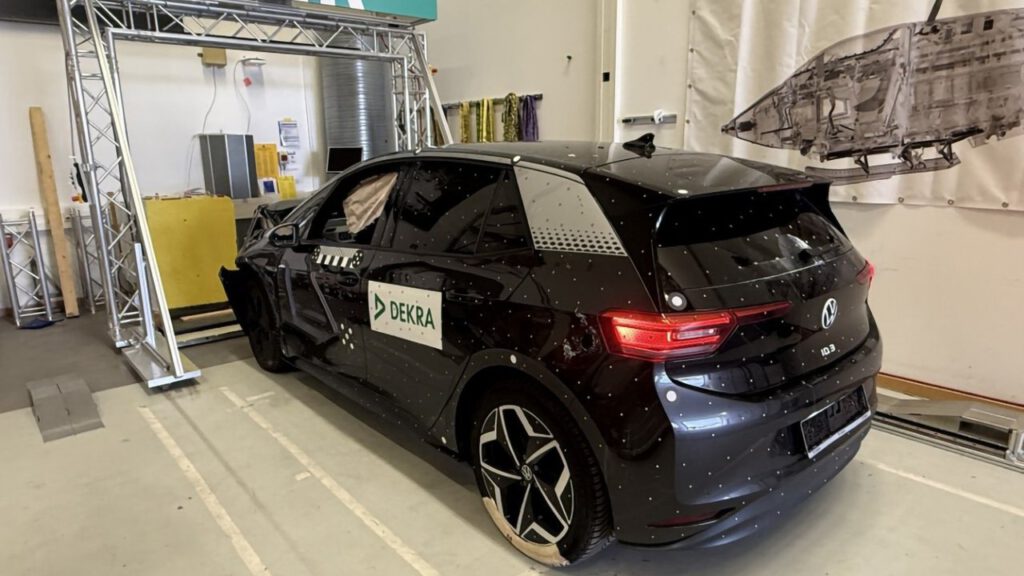
The researchers evaluated the system using a VW ID.3 that had undergone a laboratory frontal crash test at DEKRA, colliding with the rear of a stationary VW Tiguan at 79 km/h. Despite substantial deformation to the vehicle’s front section, the X-ray projections showed no safety-critical structural irregularities in the underbody battery. Analysis of its nine modules found a uniform cell arrangement, parallel cell boundaries and no overlaps or bulging. Combined with a DEKRA hazard assessment, Event Data Recorder data, battery management system data and electrical testing, the battery was classified as EUCAR Hazard Level 0 and deemed suitable for continued use in this case.
AIR was also tested on a crashed traction battery containing cylindrical cells. Automated position analysis identified an area with substantial mechanical deformation and several displaced cells compared with a reference dataset. Although the projections showed no indications of swelling, further use was not recommended because of the deformation.
Fraunhofer IIS said X-ray findings complement rather than replace electrical testing and case-specific safety evaluations. The method could support decisions on second-life use, storage, transportation, diagnostics or recycling. A planned Giant-Eye CT system in Fürth is expected to extend the approach to three-dimensional analysis of complete electric vehicles.
Source: iis.fraunhofer.de