
Transport & Environment (T&E) said Europe’s battery value chain has lost momentum but retains enough planned capacity to support sourcing requirements under the Industrial Accelerator Act (IAA). In an analysis published on January 1, 2026, the group found that one-quarter of EU battery cell capacity announced since 2022 has been canceled or shelved. Germany’s 2035 project pipeline has halved, while non-European companies, predominantly South Korean manufacturers, account for more than 72% of active cell manufacturing across Europe.
More than half of the cells in EVs sold in the EU are already manufactured in the region, according to T&E. Based on expected output rather than nameplate capacity, EU cell production could supply corporate EV demand by 2027. By 2030, it could meet demand from both corporate and private vehicles eligible for support. Europe is also on track to produce more than 100 GWh of lithium iron phosphate cells by 2030, potentially reaching 140 GWh if all projects proceed.
For cathode active materials, T&E said announced European capacity could at least meet corporate vehicle demand. However, China could retain more than 80% of global cathode production in 2035, compared with 3% in Europe. The group identified precursor cathode active material as a weaker part of the supply chain: of 552.6 GWh in European pCAM capacity announcements for 2030, only 217.9 GWh remains on track.
T&E also challenged ACEA’s projected 150 GWh battery gap for 2028. It said the estimate excludes cells exported in EU-assembled vehicles and cells not aligned with current local assembly arrangements. T&E expects the cost differential between EU and Chinese cells to decline by 70% by 2030, adding about €500 to the cost of an average EV.
The group recommended retaining cell requirements for 2027 and 2028 and cathode requirements for 2030. It also proposed 2032 minimum thresholds of 20% for pCAM and 10% for anode active material, as well as a 20% threshold for lithium, nickel, cobalt and graphite. T&E further called for EU-made batteries in small battery-electric vehicles from 2029 or 2030 and opposed carmakers’ proposed 70% fleet-wide compliance mechanism.
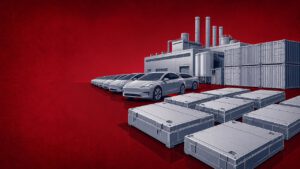
EU cells can meet EV demand by 2030
Existing EU cell production can cover corporate and private EV demand by 2030, but midstream capacity still needs policy support.
Since 2022, a quarter of capacity was cancelled or paused, Germany’s 2035 pipeline halved, and a 70% fleet booster risks further dilution.
Source: transportenvironment.org